
07 01 20 Maths Dividing by 3 I
07. 01. 20 Maths: Dividing by 3 I have made sure that the answers are available for each set of questions, so that you can mark your work.
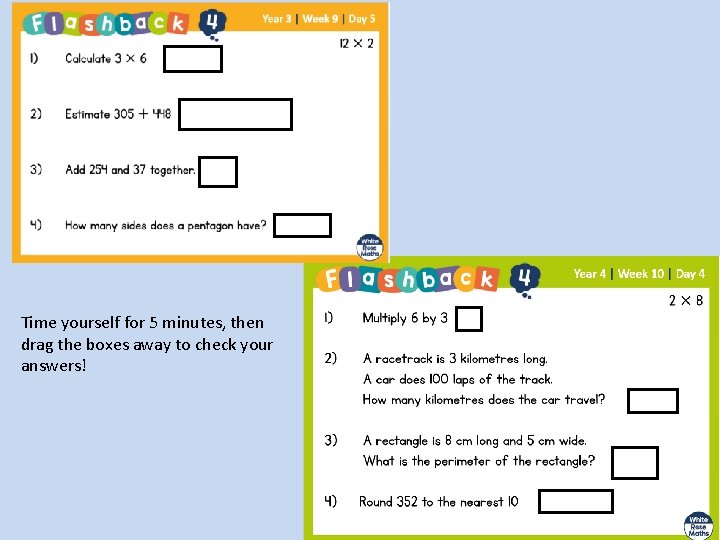
Time yourself for 5 minutes, then drag the boxes away to check your answers!
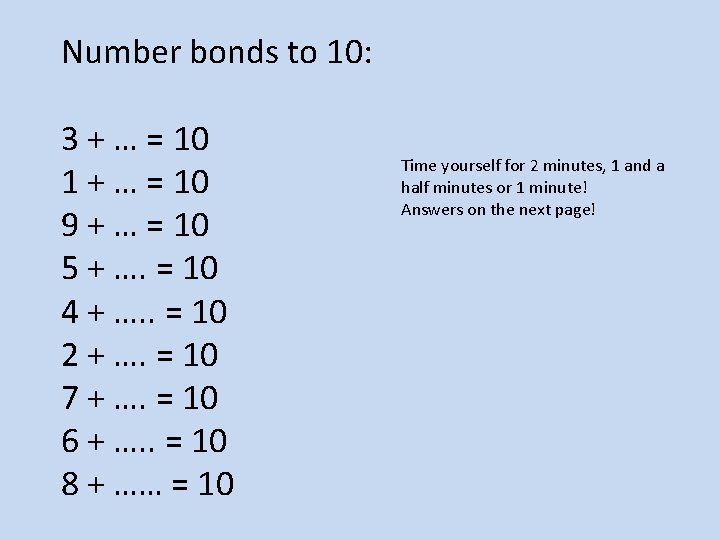
Number bonds to 10: 3 + … = 10 1 + … = 10 9 + … = 10 5 + …. = 10 4 + …. . = 10 2 + …. = 10 7 + …. = 10 6 + …. . = 10 8 + …… = 10 Time yourself for 2 minutes, 1 and a half minutes or 1 minute! Answers on the next page!
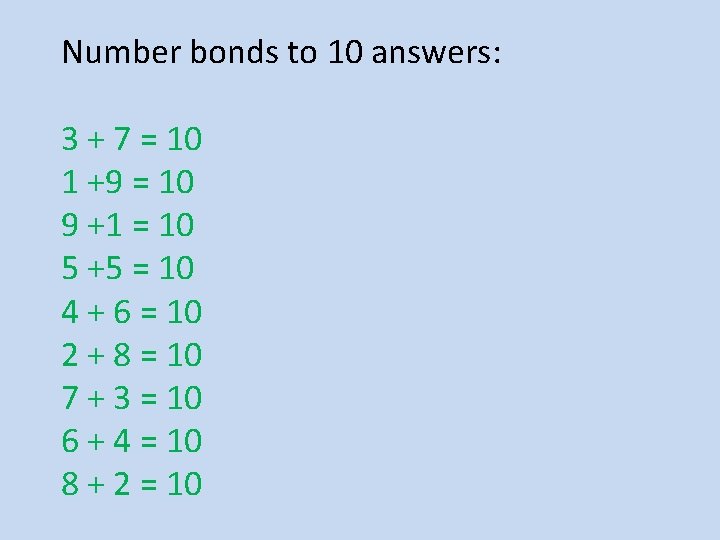
Number bonds to 10 answers: 3 + 7 = 10 1 +9 = 10 9 +1 = 10 5 +5 = 10 4 + 6 = 10 2 + 8 = 10 7 + 3 = 10 6 + 4 = 10 8 + 2 = 10
Let’s begin by counting in 3’s again. Jot down the 3 times table up to 12 x. Today we are going to be dividing by 3. What does it mean to divide?

Dividing is the opposite operation to multiplication. When we divide we share a number into equal groups. E. g. 15 ÷ 3 Share 15 into 3 equal groups (pictoral): There are 3 equal groups of 5. So 15 ÷ 3 = 5 Can you draw equal groups to answer: 1. 12 ÷ 3 2. 21 ÷ 3 3. 18 ÷ 3 (Answers on the next page)
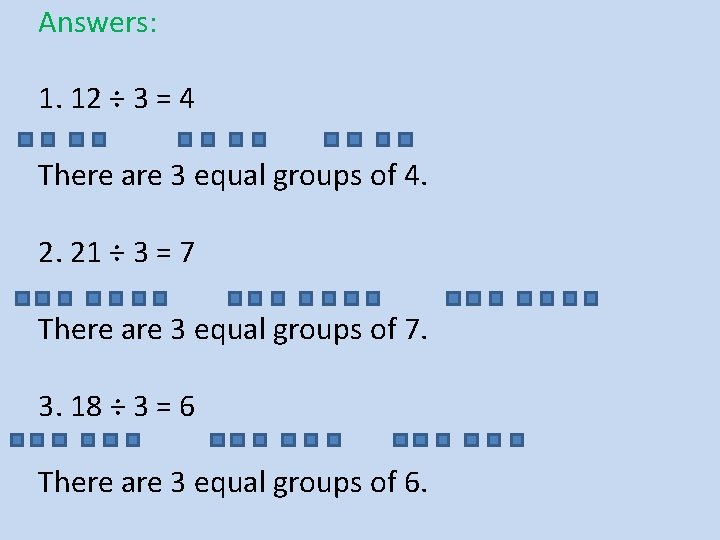
Answers: 1. 12 ÷ 3 = 4 There are 3 equal groups of 4. 2. 21 ÷ 3 = 7 There are 3 equal groups of 7. 3. 18 ÷ 3 = 6 There are 3 equal groups of 6.
Division questions may be put into worded problems: There are 24 coloured pencils that need to be shared equally between 3 pupils. How many pencils will each pupil get? Use equal groups to support you answering the division question. Answer on the next page.
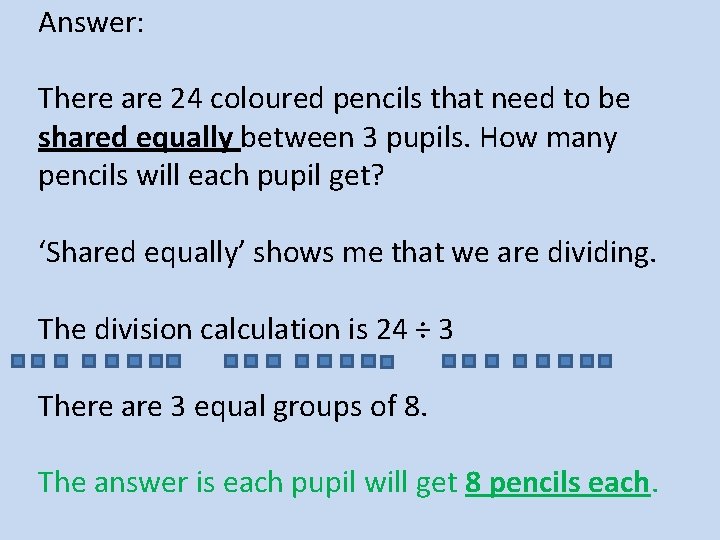
Answer: There are 24 coloured pencils that need to be shared equally between 3 pupils. How many pencils will each pupil get? ‘Shared equally’ shows me that we are dividing. The division calculation is 24 ÷ 3 There are 3 equal groups of 8. The answer is each pupil will get 8 pencils each.
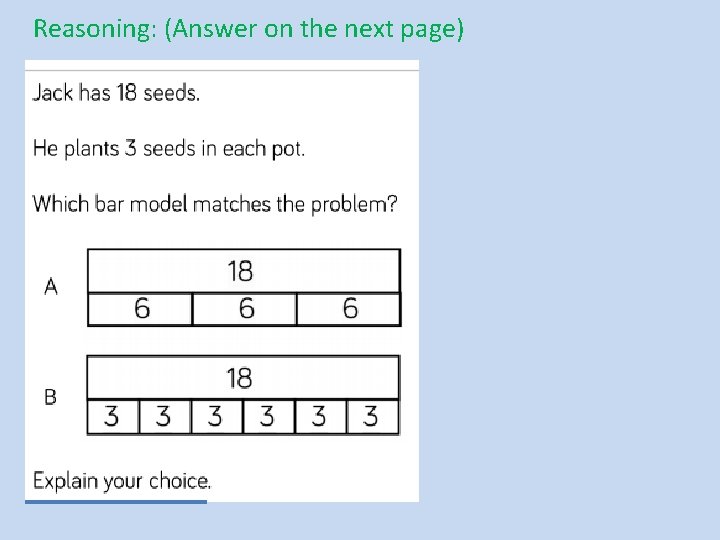
Reasoning: (Answer on the next page)
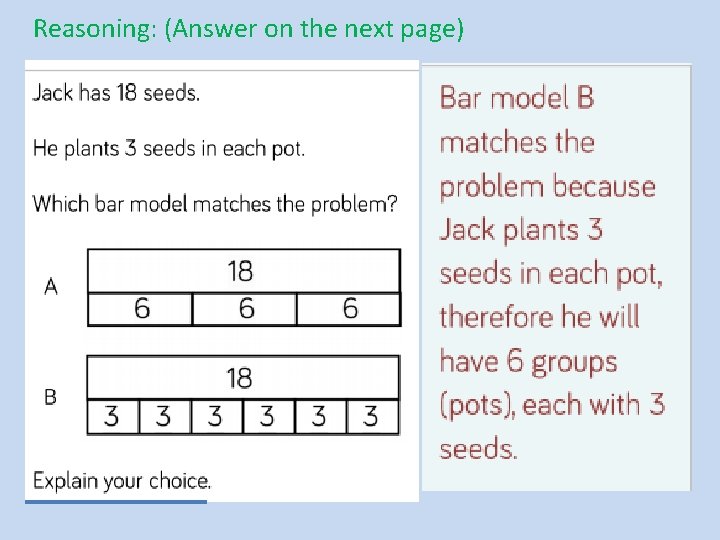
Reasoning: (Answer on the next page)
If you would like to do some more maths practise please log onto times table rockstar for times table practise. Or Mathletics, where I have set some further multiplication/division activities for year 3/4.
- Slides: 12