
06 BT 82 Unit 1 Biotechnology and Society
06 BT 82 Unit 1: Biotechnology and Society
Biotechnology & Hunger • World hunger and food insecurity is a recurring problem in most parts of the developing world • GM crops possessing genes from different species, could relieve global food shortages • Export earnings from higher agricultural yields can contribute to reducing food insecurity and hunger in developing countries
• Biotechnological intervention confers advantages in crop development – Livestock management, Storage of agricultural products – Increasing crop yields, Reduced use of fertilizers, herbicides and pesticides. • Biotechnology offers – a very promising alternative to synthetic foods – an improvement on conventional plant-breeding technologies
Biotech products to remove hunger • Golden Rice • High iron Rice • Flavr Savr Tomato • Genetically modified Crops – Maize – Potato – Melon – Papaya – Soybean – Canola
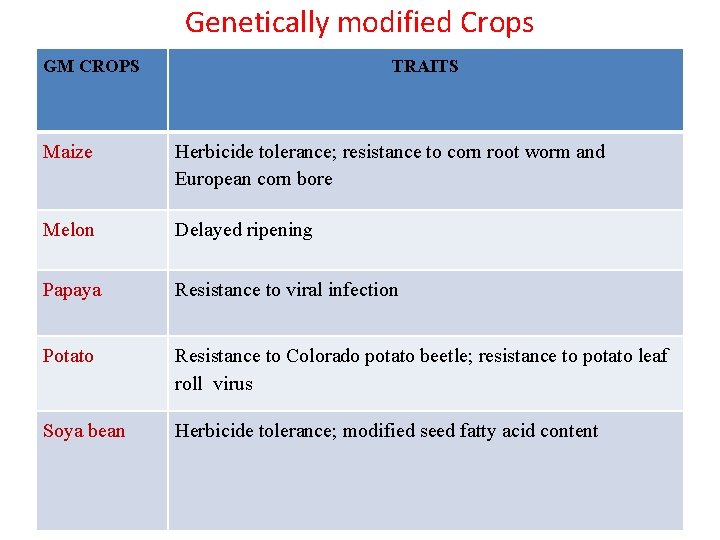
Genetically modified Crops GM CROPS TRAITS Maize Herbicide tolerance; resistance to corn root worm and European corn bore Melon Delayed ripening Papaya Resistance to viral infection Potato Resistance to Colorado potato beetle; resistance to potato leaf roll virus Soya bean Herbicide tolerance; modified seed fatty acid content

Golden Rice • Beta- carotene (Provitamin A) rich rice • 3 transgenes incorporated in rice – Phytoene synthase – Phytoene desaturase and Zeta- carotene desaturase – Lycopene cyclase • Mode: Agrobacterium mediated transformation
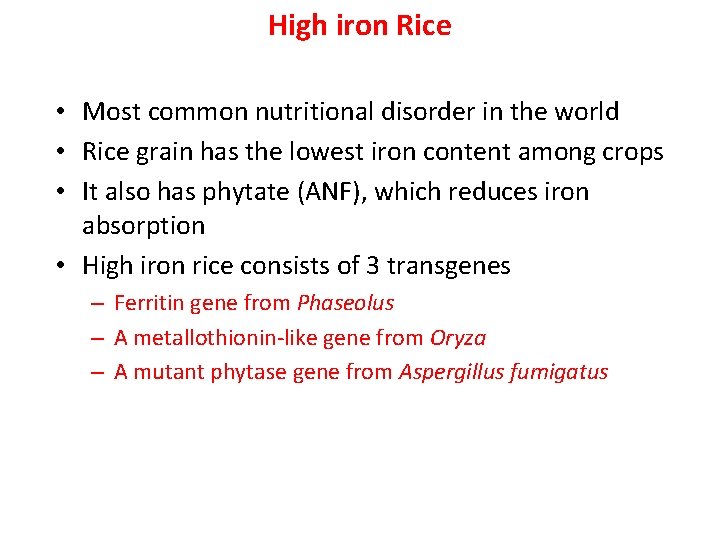
High iron Rice • Most common nutritional disorder in the world • Rice grain has the lowest iron content among crops • It also has phytate (ANF), which reduces iron absorption • High iron rice consists of 3 transgenes – Ferritin gene from Phaseolus – A metallothionin-like gene from Oryza – A mutant phytase gene from Aspergillus fumigatus
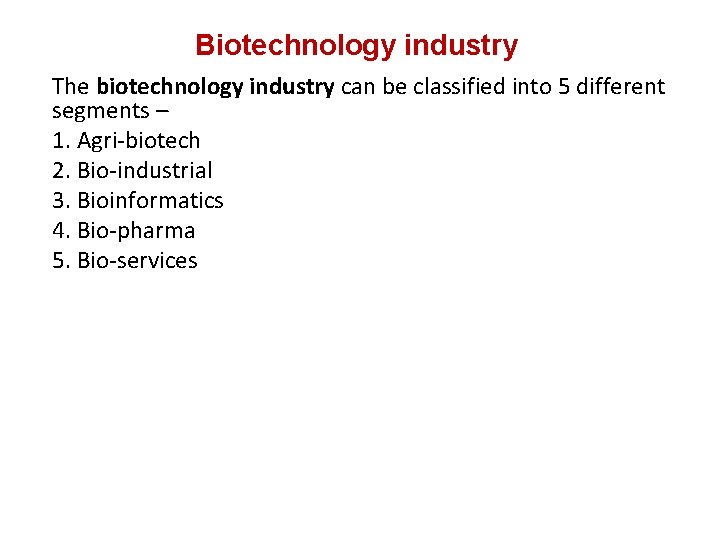
Biotechnology industry The biotechnology industry can be classified into 5 different segments – 1. Agri-biotech 2. Bio-industrial 3. Bioinformatics 4. Bio-pharma 5. Bio-services
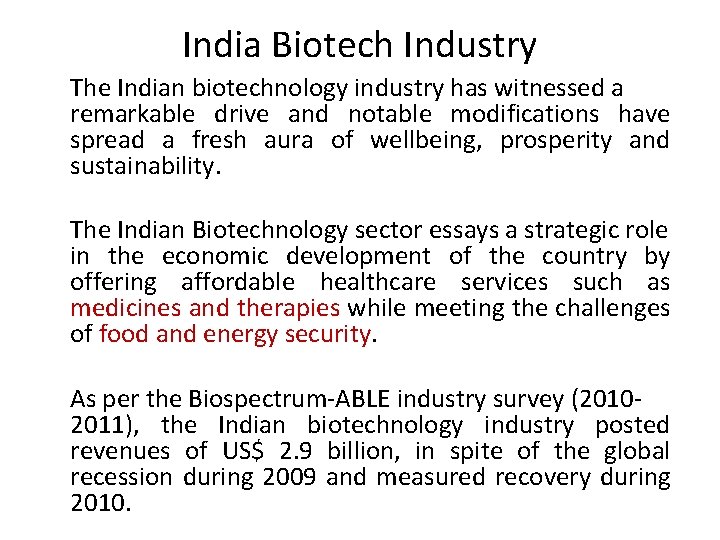
India Biotech Industry The Indian biotechnology industry has witnessed a remarkable drive and notable modifications have spread a fresh aura of wellbeing, prosperity and sustainability. The Indian Biotechnology sector essays a strategic role in the economic development of the country by offering affordable healthcare services such as medicines and therapies while meeting the challenges of food and energy security. As per the Biospectrum-ABLE industry survey (20102011), the Indian biotechnology industry posted revenues of US$ 2. 9 billion, in spite of the global recession during 2009 and measured recovery during 2010.
Promises and challenges of Biotechnology in India The biotech sector is growing at 46 percent increase in revenue last year in the Asia-Pacific region – India already figures in the elite club of 5 nations in the Asia-Pacific region – identified by Ernst & Young as emerging biotech leaders
• Pharma companies in the West to look to countries like India beyond their own borders because of – Mounting cost of drug discovery and development, • Extended timelines for bringing new drugs to market, fierce competition pricing pressure and funding challenges Astra Zeneca and GE, for instance, already have significant research centers in India – Several international bio-partnerships already dot the Indian biotech landscape with more on the anvil – –
The road ahead… Advantage like: • Economical manufacturing costs • High quality drug research facilities • Skilled and cost-competitive manpower has promoted India on the global platform of the biotechnology sector and is considered to be one of the major competitors in the race to become a leading global player. Besides offering a fast expanding domestic market, India provides a number of benefits to attract multinational companies from across the globe.
Indian biotech industry • Western Biocluster emerged as the biggest contributor , followed by the Southern Biocluster contributing Rs. 5538 crores. • Western India continued to dominate India’s biotech industry with 46% share in the overall revenues of Rs. 14, 199 crores from 137 companies in the region. • Southern region continues to remain India’s largest Biotech cluster in terms of the number of companies adding 9 new biotech companies (with a , highest in the country during the year. The region has 172 biotech companies and shared 39%
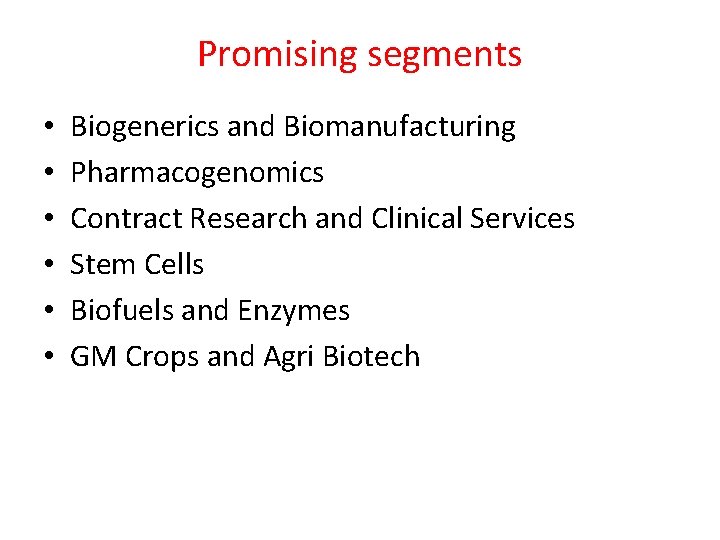
Promising segments • • • Biogenerics and Biomanufacturing Pharmacogenomics Contract Research and Clinical Services Stem Cells Biofuels and Enzymes GM Crops and Agri Biotech
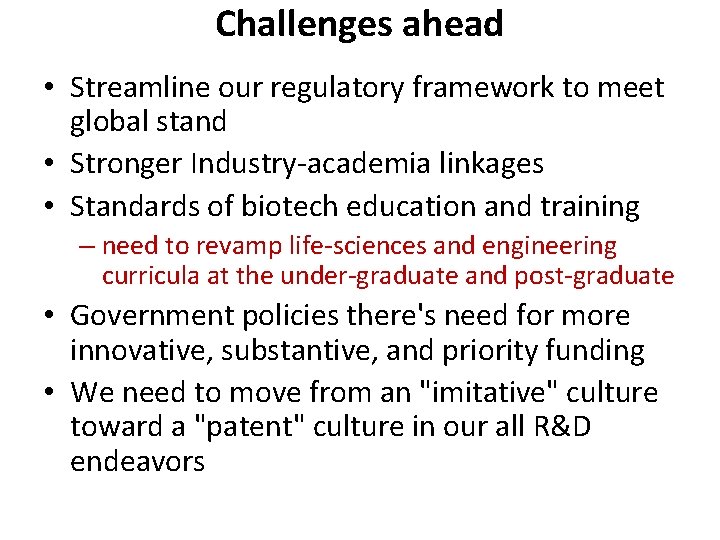
Challenges ahead • Streamline our regulatory framework to meet global stand • Stronger Industry-academia linkages • Standards of biotech education and training – need to revamp life-sciences and engineering curricula at the under-graduate and post-graduate • Government policies there's need for more innovative, substantive, and priority funding • We need to move from an "imitative" culture toward a "patent" culture in our all R&D endeavors
- Slides: 15