
040110 Brief Review of Recognition Context Computer Vision
04/01/10 Brief Review of Recognition + Context Computer Vision CS 543 / ECE 549 University of Illinois Derek Hoiem
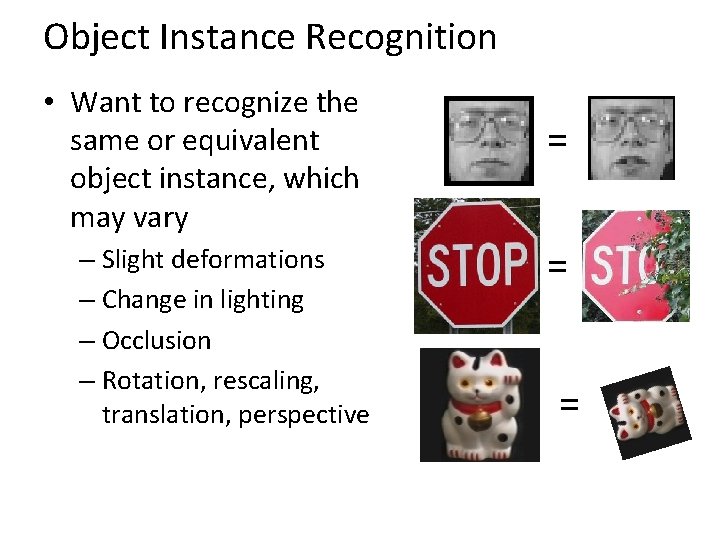
Object Instance Recognition • Want to recognize the same or equivalent object instance, which may vary – Slight deformations – Change in lighting – Occlusion – Rotation, rescaling, translation, perspective = = =
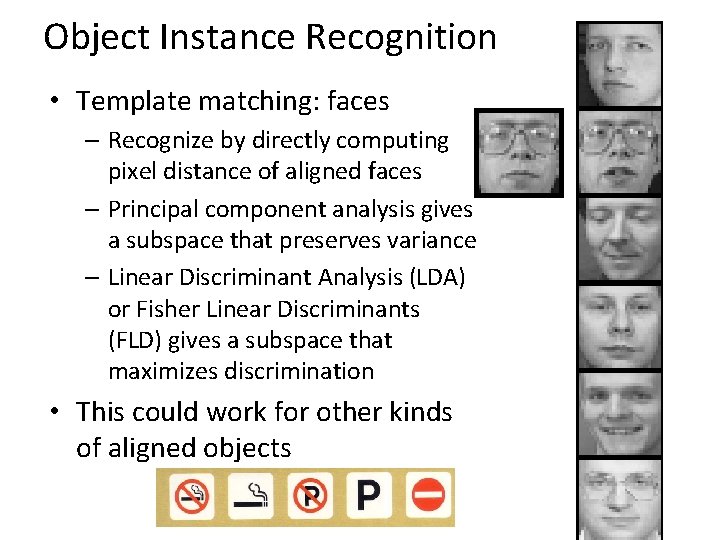
Object Instance Recognition • Template matching: faces – Recognize by directly computing pixel distance of aligned faces – Principal component analysis gives a subspace that preserves variance – Linear Discriminant Analysis (LDA) or Fisher Linear Discriminants (FLD) gives a subspace that maximizes discrimination • This could work for other kinds of aligned objects
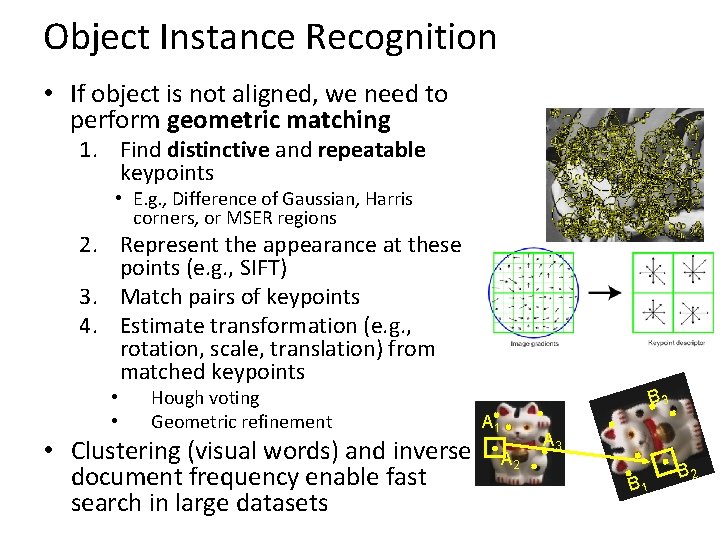
Object Instance Recognition • If object is not aligned, we need to perform geometric matching 1. Find distinctive and repeatable keypoints • E. g. , Difference of Gaussian, Harris corners, or MSER regions 2. Represent the appearance at these points (e. g. , SIFT) 3. Match pairs of keypoints 4. Estimate transformation (e. g. , rotation, scale, translation) from matched keypoints • • Hough voting Geometric refinement • Clustering (visual words) and inverse document frequency enable fast search in large datasets B 3 A 1 A 2 A 3 B 1 B 2
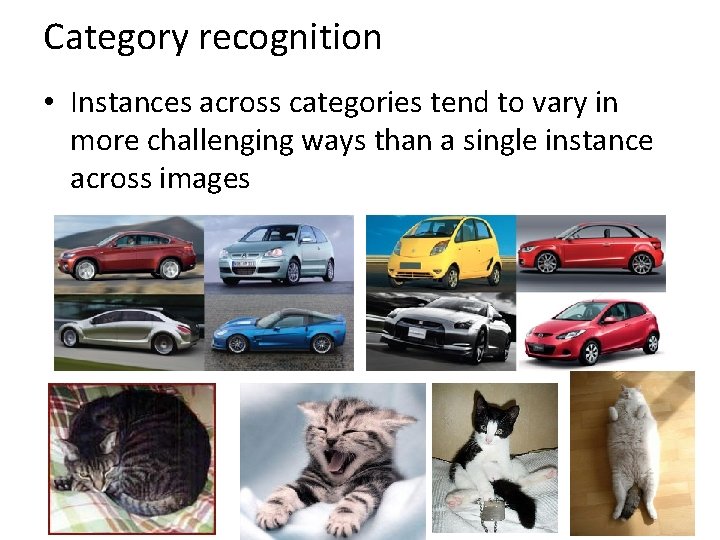
Category recognition • Instances across categories tend to vary in more challenging ways than a single instance across images
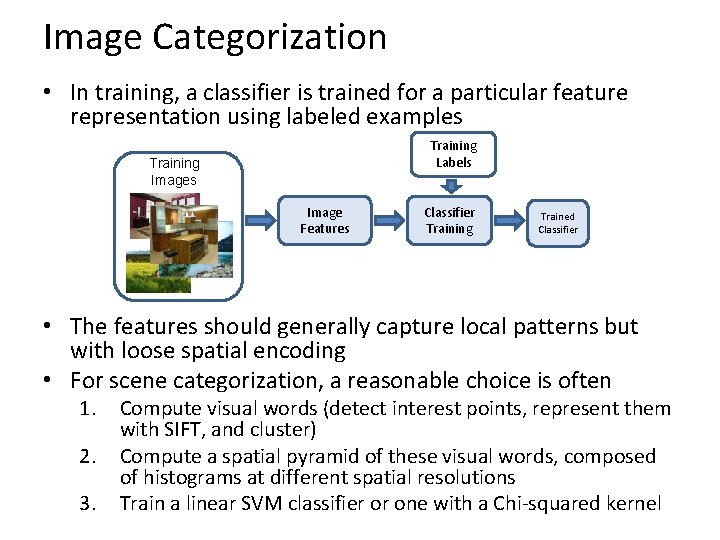
Image Categorization • In training, a classifier is trained for a particular feature representation using labeled examples Training Labels Training Images Image Features Classifier Training Trained Classifier • The features should generally capture local patterns but with loose spatial encoding • For scene categorization, a reasonable choice is often 1. 2. 3. Compute visual words (detect interest points, represent them with SIFT, and cluster) Compute a spatial pyramid of these visual words, composed of histograms at different spatial resolutions Train a linear SVM classifier or one with a Chi-squared kernel
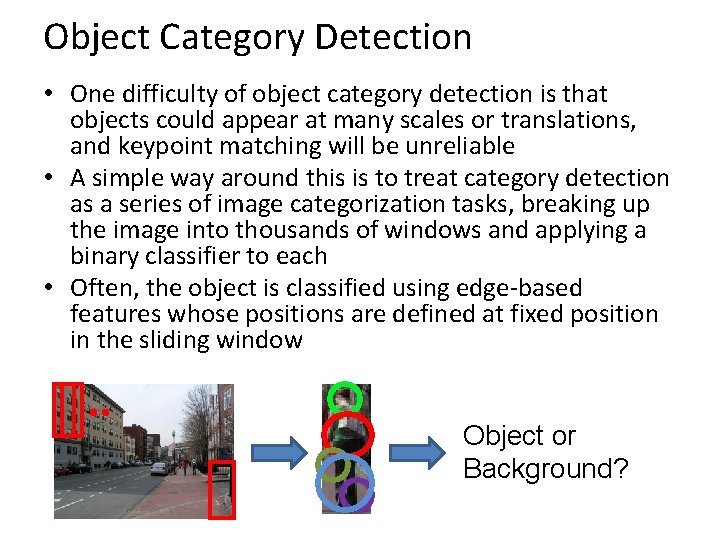
Object Category Detection • One difficulty of object category detection is that objects could appear at many scales or translations, and keypoint matching will be unreliable • A simple way around this is to treat category detection as a series of image categorization tasks, breaking up the image into thousands of windows and applying a binary classifier to each • Often, the object is classified using edge-based features whose positions are defined at fixed position in the sliding window Object or Background?
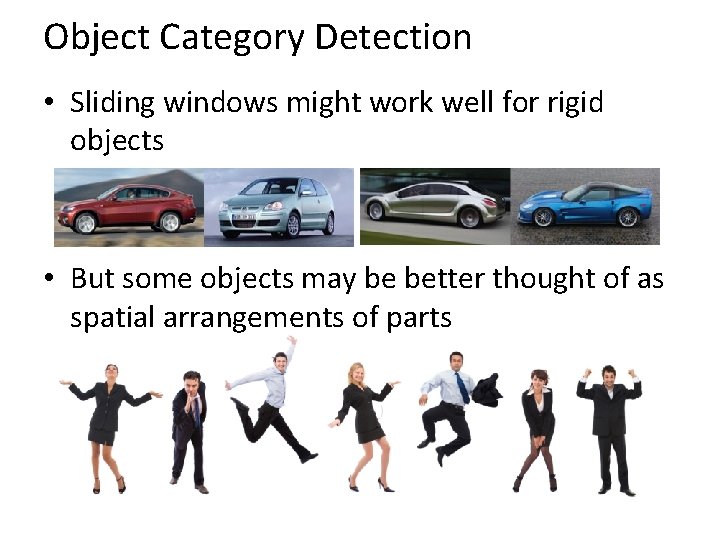
Object Category Detection • Sliding windows might work well for rigid objects • But some objects may be better thought of as spatial arrangements of parts
Object Category Detection • Part-based models have three key components – Part definition and appearance model – Model of geometry or layout of parts – Algorithm for efficient search • ISM Model – Parts are clustered detected keypoints – Position of each part wrt object center/size is recorded – Search is done through Hough voting / Mean-shift clustering combination • Pictorial structures model – Parts are rectangles detected in silhouette – Layout is articulated model with tree-shaped graph – Search through dynamic programming or probabilistic sampling
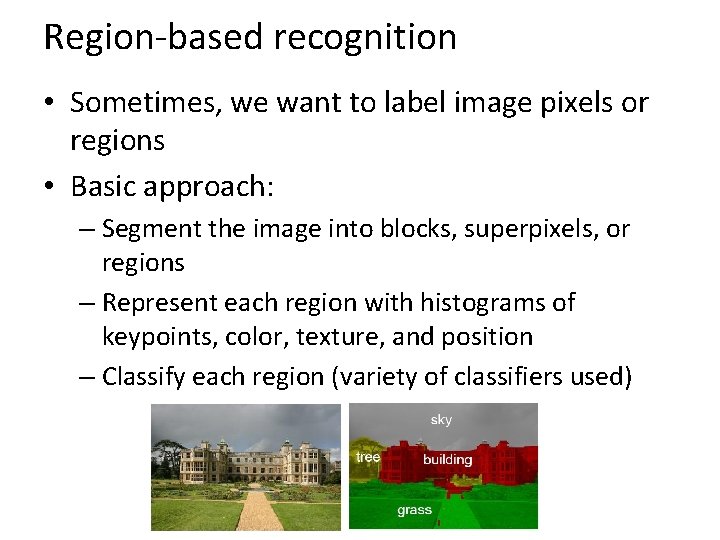
Region-based recognition • Sometimes, we want to label image pixels or regions • Basic approach: – Segment the image into blocks, superpixels, or regions – Represent each region with histograms of keypoints, color, texture, and position – Classify each region (variety of classifiers used)
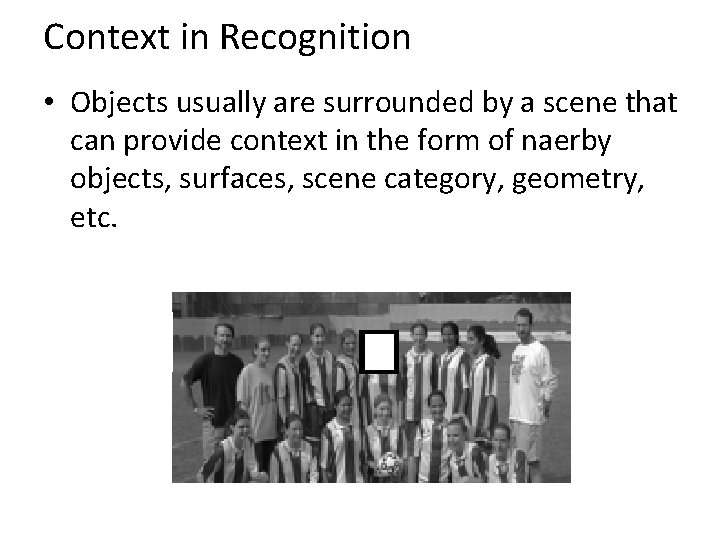
Context in Recognition • Objects usually are surrounded by a scene that can provide context in the form of naerby objects, surfaces, scene category, geometry, etc.
Context provides clues for function • What is this? These examples from Antonio Torralba
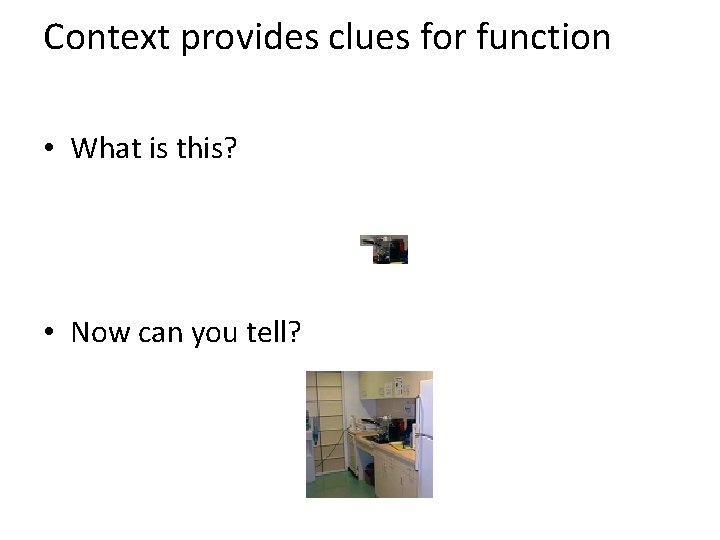
Context provides clues for function • What is this? • Now can you tell?
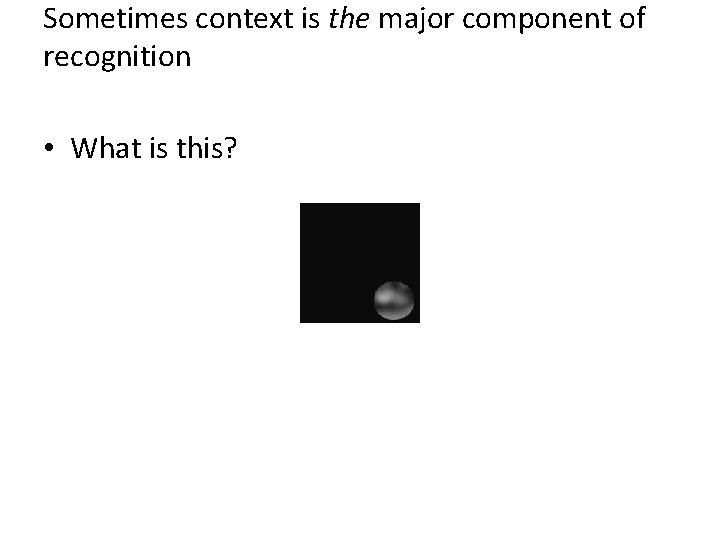
Sometimes context is the major component of recognition • What is this?
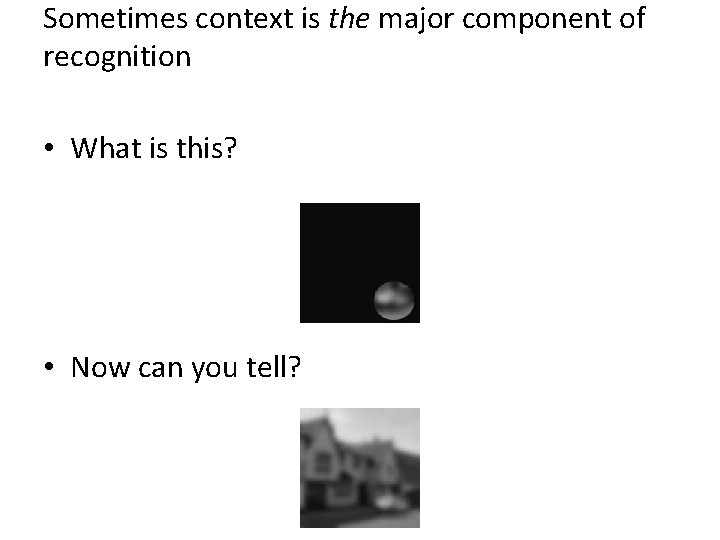
Sometimes context is the major component of recognition • What is this? • Now can you tell?
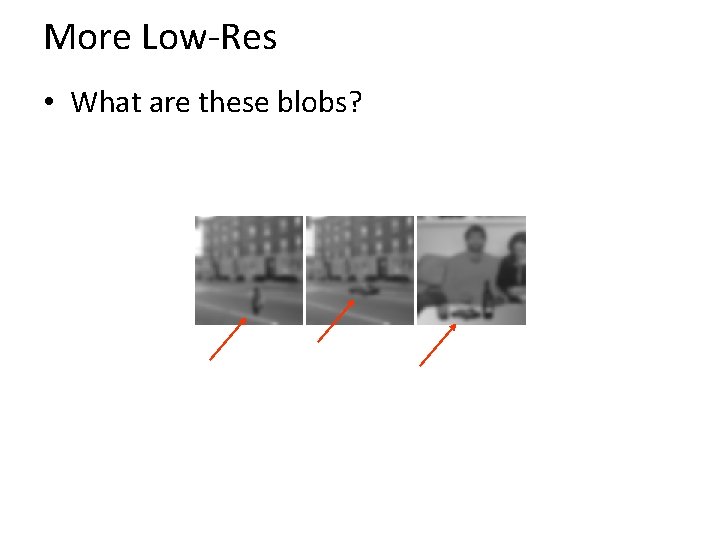
More Low-Res • What are these blobs?
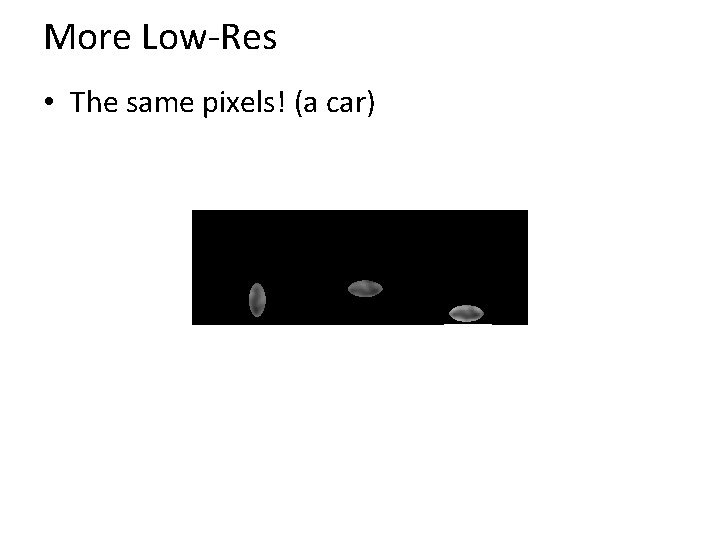
More Low-Res • The same pixels! (a car)
We will see more on context later…
- Slides: 18