
03022006 Flow Routing Reading 8 1 8 4
- Slides: 12
03/02/2006 Flow Routing Reading: 8. 1, 8. 4, 9. 1, 9. 2
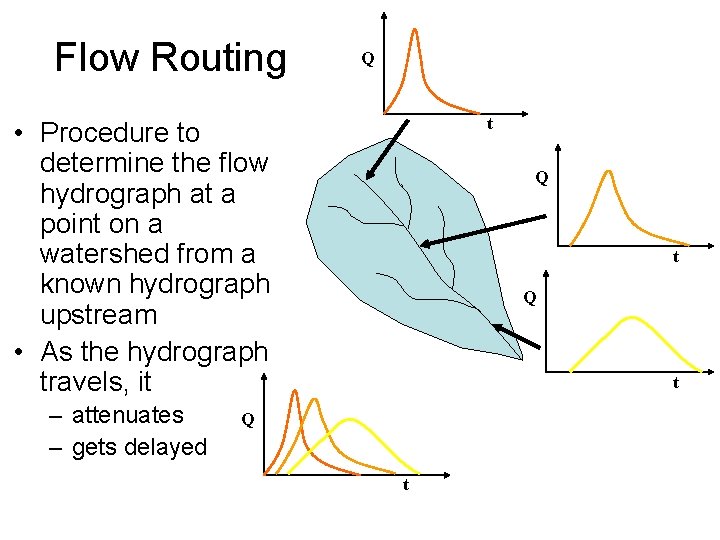
Flow Routing Q t • Procedure to determine the flow hydrograph at a point on a watershed from a known hydrograph upstream • As the hydrograph travels, it – attenuates – gets delayed Q t Q t
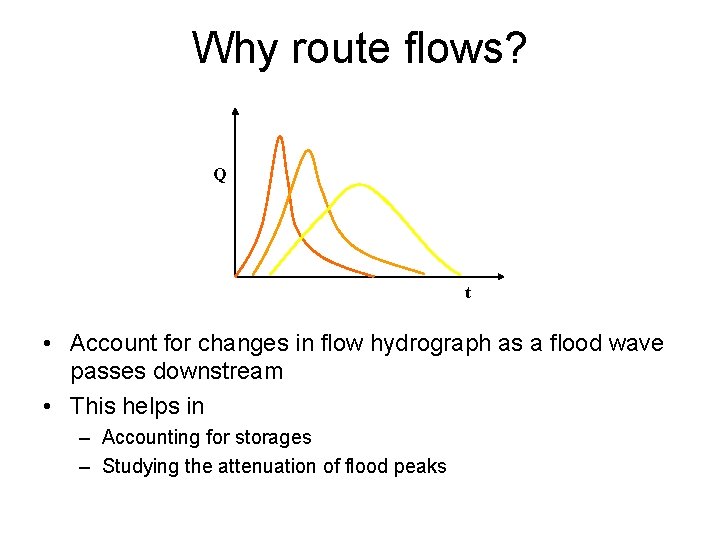
Why route flows? Q t • Account for changes in flow hydrograph as a flood wave passes downstream • This helps in – Accounting for storages – Studying the attenuation of flood peaks
Types of flow routing • Lumped/hydrologic – Flow is calculated as a function of time alone at a particular location – Governed by continuity equation and flow/storage relationship • Distributed/hydraulic – Flow is calculated as a function of space and time throughout the system – Governed by continuity and momentum equations
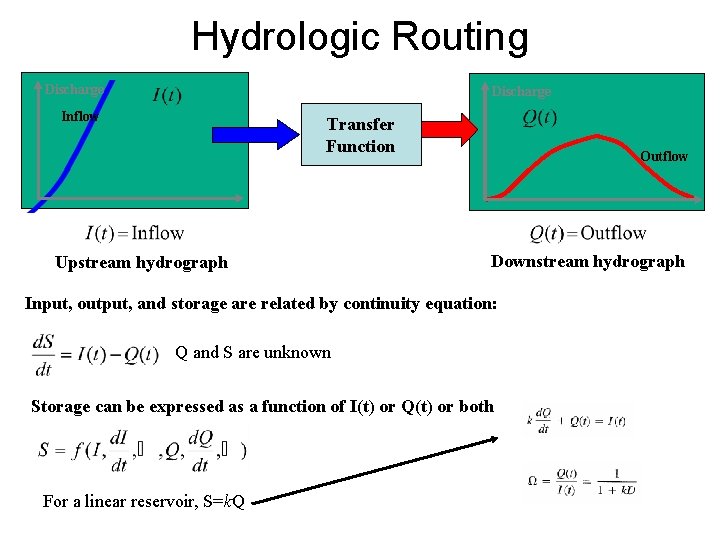
Hydrologic Routing Discharge Inflow Transfer Function Upstream hydrograph Outflow Downstream hydrograph Input, output, and storage are related by continuity equation: Q and S are unknown Storage can be expressed as a function of I(t) or Q(t) or both For a linear reservoir, S=k. Q
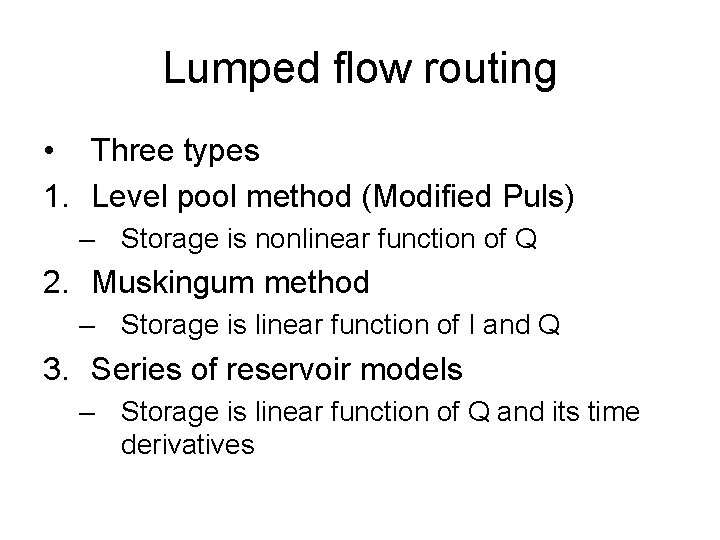
Lumped flow routing • Three types 1. Level pool method (Modified Puls) – Storage is nonlinear function of Q 2. Muskingum method – Storage is linear function of I and Q 3. Series of reservoir models – Storage is linear function of Q and its time derivatives
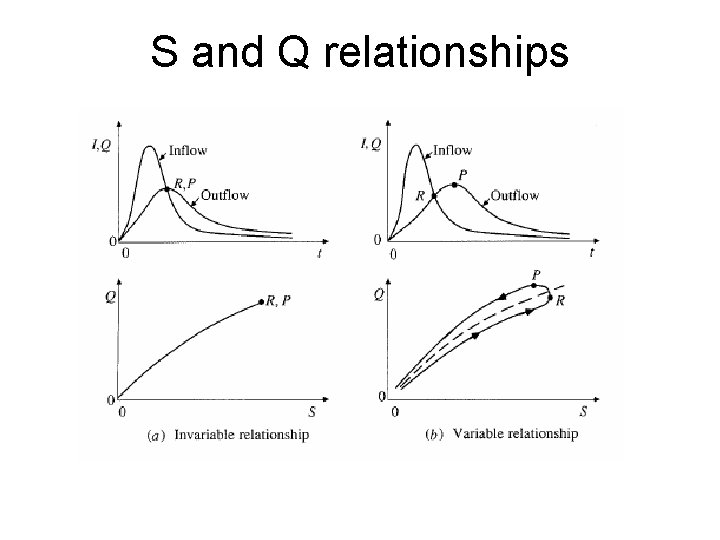
S and Q relationships
Level pool routing • Procedure for calculating outflow hydrograph Q(t) from a reservoir with horizontal water surface, given its inflow hydrograph I(t) and storage-outflow relationship
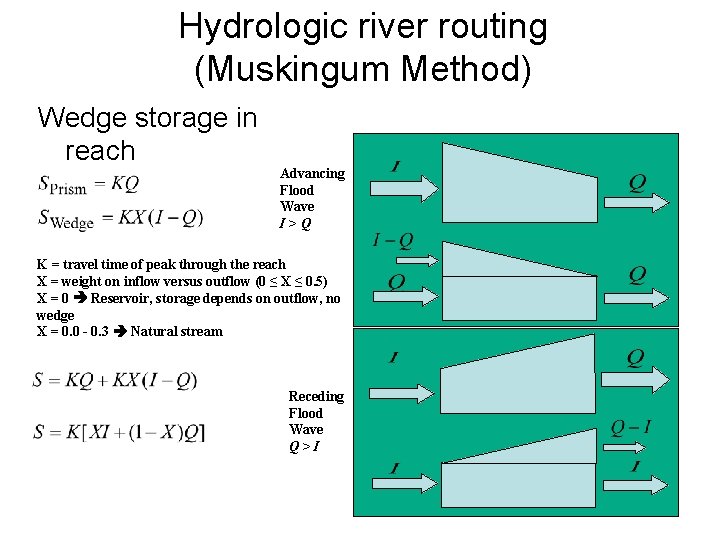
Hydrologic river routing (Muskingum Method) Wedge storage in reach Advancing Flood Wave I>Q K = travel time of peak through the reach X = weight on inflow versus outflow (0 ≤ X ≤ 0. 5) X = 0 Reservoir, storage depends on outflow, no wedge X = 0. 0 - 0. 3 Natural stream Receding Flood Wave Q>I
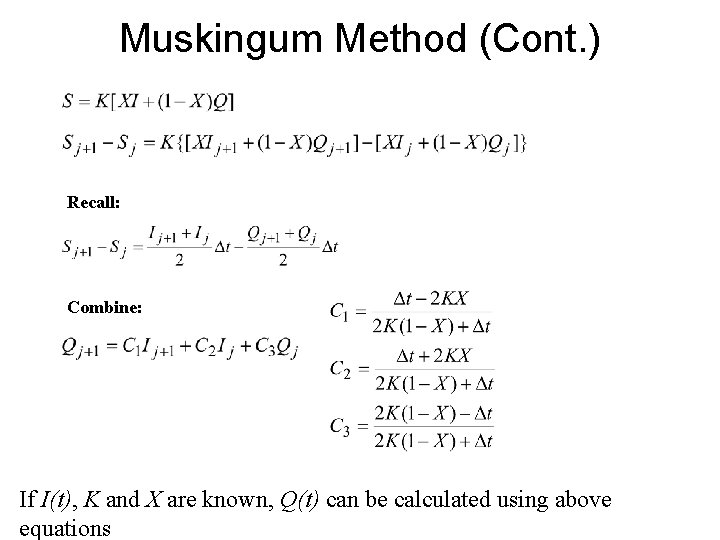
Muskingum Method (Cont. ) Recall: Combine: If I(t), K and X are known, Q(t) can be calculated using above equations
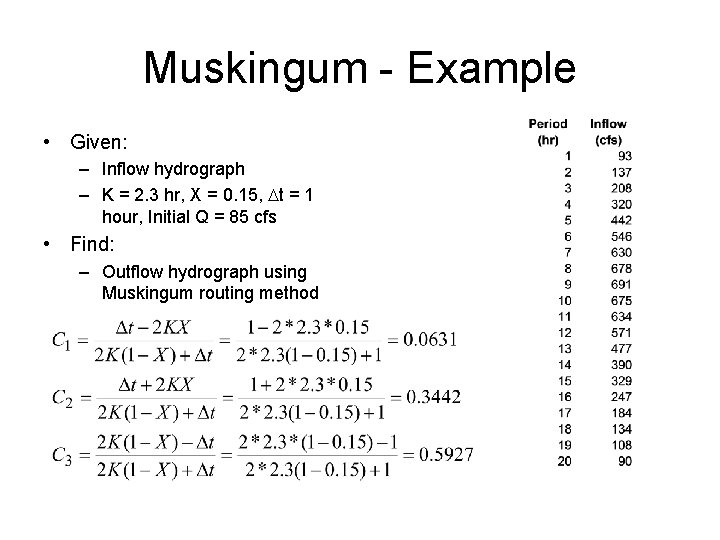
Muskingum - Example • Given: – Inflow hydrograph – K = 2. 3 hr, X = 0. 15, Dt = 1 hour, Initial Q = 85 cfs • Find: – Outflow hydrograph using Muskingum routing method
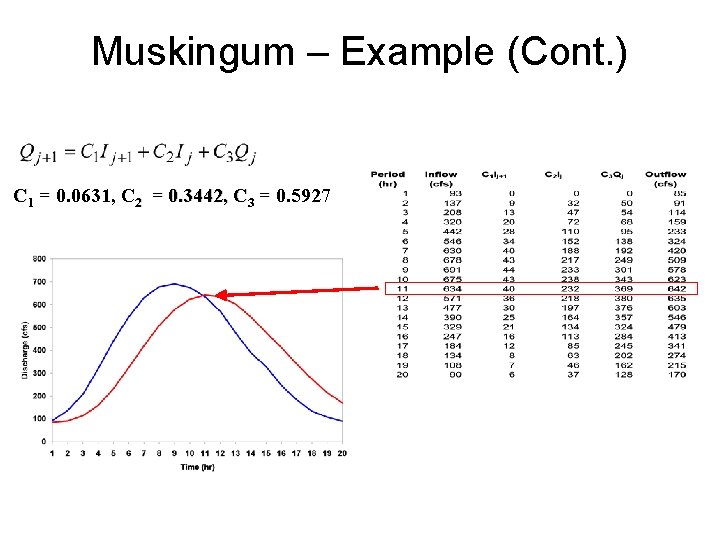
Muskingum – Example (Cont. ) C 1 = 0. 0631, C 2 = 0. 3442, C 3 = 0. 5927