
03 October 2020 A costly consideration 1 1
03 October 2020 A costly consideration 1. 1. Calculating costs, revenues and profits Objectives: Identify, explain and calculate Fixed, Variable and Total costs Distinguish between cost and price as key business concepts
Why is it important for Managers to know and understand business costs? o. DISCUSS
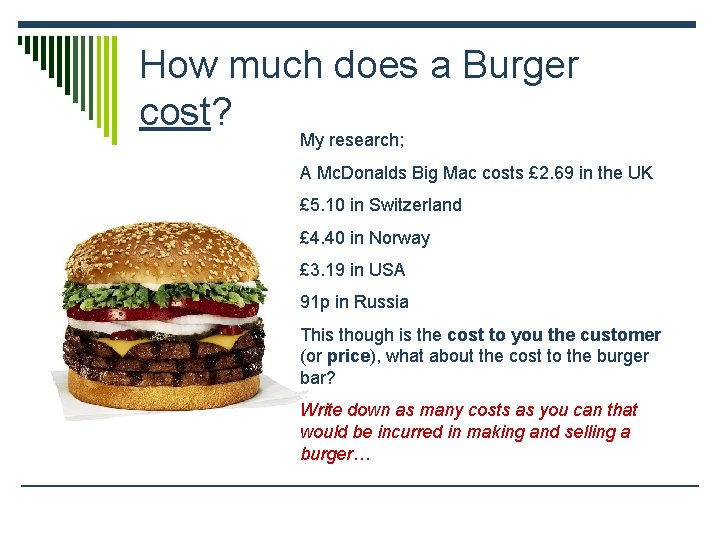
How much does a Burger cost? My research; A Mc. Donalds Big Mac costs £ 2. 69 in the UK £ 5. 10 in Switzerland £ 4. 40 in Norway £ 3. 19 in USA 91 p in Russia This though is the cost to you the customer (or price), what about the cost to the burger bar? Write down as many costs as you can that would be incurred in making and selling a burger…
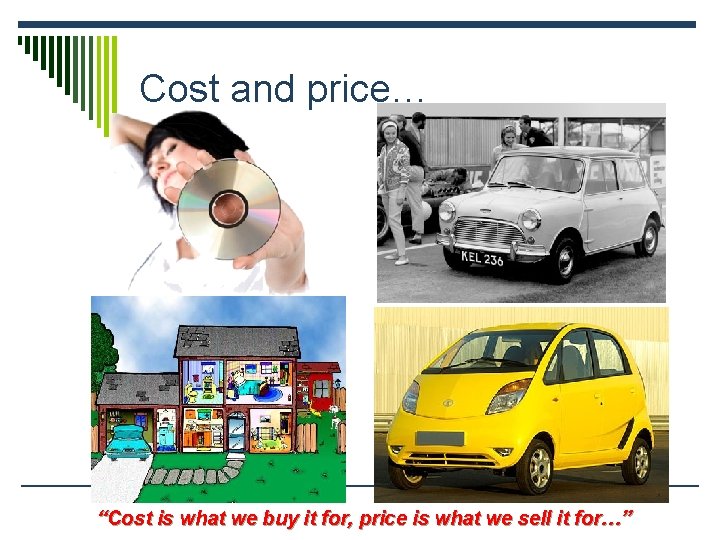
Cost and price… “Cost is what we buy it for, price is what we sell it for…”
Costs Cost – “the price of resources needed to produce a good or service” We can divide these costs into two categories; n n Fixed Costs Variable Costs
Fixed Costs o FIXED COSTS DO NOT CHANGE WITH THE LEVEL OF GOODS OR SERVICES PRODUCED, they need to be paid whether 1 or 1 million products are being made… Example: Whether full of customers or closed, a coffee shop will need to pay rent, so this is a fixed cost
Variable Costs o VARIABLE COSTS DO CHANGE WITH THE LEVEL OF GOODS OR SERVICES PRODUCED, as more goods are made the variable costs increase Example: As a coffee shop sells more cups of coffee, it will have to buy more coffee beans, so these are a variable cost.
Semi-Variable Costs o A cost with fixed and variable features Example: The coffee shop has a phone-line. The phone bill includes line rental of £ 10 (fixed) and each call made is 20 p (variable).
Setting the Scene Rashid was pleased with himself. In his first month of trading he has sold and fitted 10 car satellite navigation systems, two more than originally forecast in his Business Plan. Rashid’s electrical skills and his friendly personality had impressed his customers. He had purchased the first 50 satellite navigation kits from a website specialising in stock sell-offs from failed businesses. He had paid £ 100 each. This had swallowed up most of his start-up capital. He rented a small lock up garage for £ 120 a month. The large sign he fixed to the doors had cost him £ 120 but attracted a lot of attention. Other advertising costs in his first month had been more than expected. The local newspaper had just increased its classified rates - £ 150 was £ 30 more than planned. He sold the kits for £ 275, fully fitted. Rashid could have just sold the kits themselves, but he wanted to “add value” to them by doing the fitting too. Each fitting kit cost Rashid £ 10. Other costs – such as business rates and fixed charges for electricity – had been paid and these totalled £ 200 per month, just as predicted. He had already paid the accountant for help with setting up his business and writing a business plan. Rashid had started to work out his profit for the first month. His only real worry was that two of his customers had asked for some time to pay him. He had agreed as he wanted to make the sale. But when would they pay?
Discussion Points o What evidence is there that Rashid has thought about the costs of running his business before he set up? o How would you work out if Rashid has made a profit in the first month of training? o Why would profit be important to Rashid?
Rashid’s Costs o Classify Rashid’s Fixed and Variable Costs?
Revenue Any money received from selling goods or services is known as Sales Revenue or sales Sales Revenue is calculated as; Total number of goods sold x Selling Price Example: If a Coffee shop sold 20 cups of coffee at £ 2, its sales revenue would be (20 cups x £ 2) £ 40 What happens as to the number of goods sold as the price changes?
Perfect Definition Challenge… o Price o Variable Cost o Fixed Cost o Semi-variable Cost o Revenue Instant Kudos for the best definitions (without using your notes or textbooks etc…)
Why are costs important? o An increase in cost is a decrease in profits o A key managerial role is keeping costs down o Some firms base prices on costs (cost-plus pricing) o Rising or high costs may mean it is simply not worth producing a product
Profit and loss o The difference between revenue and costs is known as profit or loss (TR-TC) n Profit - If money is left over after all costs have been paid, the company has made a profit n Loss - If there is not enough money to pay bills, the company has made a loss Example: The coffee shop has sold £ 300 of products, whilst fixed and variable costs add up to £ 270. (£ 300 -£ 270=£ 30 profit)
Profit Is £ 1 profit worthwhile? “Satisficing” is the aim to make only a modest level of profit Two things can happen to profit; n n It can be redistributed to owners It can be reinvested in the business (retained profit) In an ‘average’ business, what should happen to the profit generated?
Why is Profit Important? o DISCUSS o Why do firms want more of it? o Why do firms care how much they earn? o What do firms do with their profit?
Why is Profit Important? o Measure of success of the business o Provide funds for investment o A magnet attracting further funds from shareholders who are enticed by the possibility of high returns on their investment o A source of finance for growth
So why is this important to analyse? Higher costs mean… n n Lower profits – (revenue minus costs equal profit) Less price competitiveness (the need for higher prices) Capital tied up in stock holding Higher opportunity costs
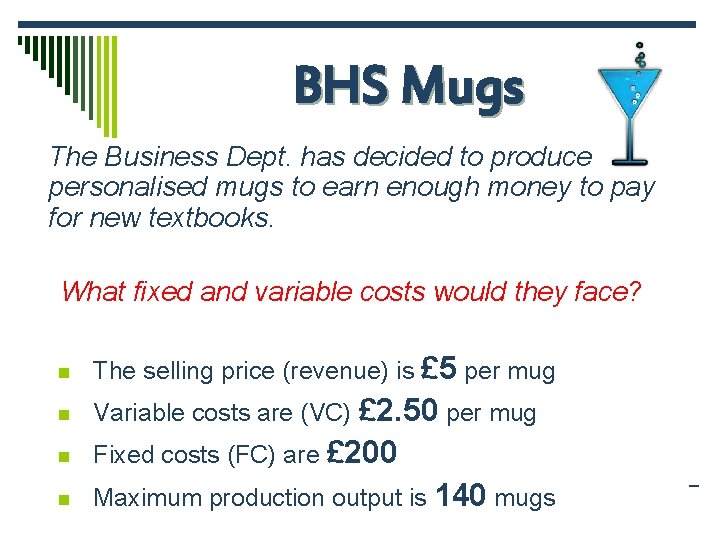
BHS Mugs The Business Dept. has decided to produce personalised mugs to earn enough money to pay for new textbooks. What fixed and variable costs would they face? n The selling price (revenue) is £ 5 per mug n Variable costs are (VC) £ 2. 50 per mug n Fixed costs (FC) are £ 200 n Maximum production output is 140 mugs
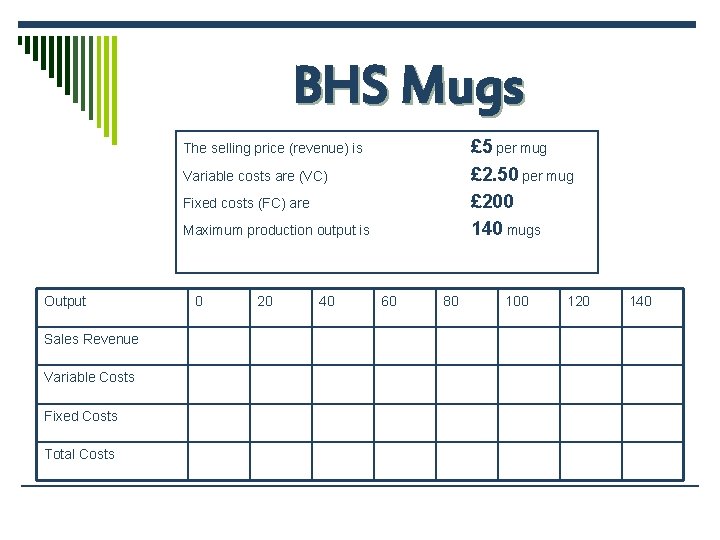
BHS Mugs £ 5 per mug £ 2. 50 per mug £ 200 140 mugs The selling price (revenue) is Variable costs are (VC) Fixed costs (FC) are Maximum production output is Output Sales Revenue Variable Costs Fixed Costs Total Costs 0 20 40 60 80 100 120 140
BHS Mugs o What is the profit/loss at different levels of output?
Case study o Gnomes United
Case Study Undertake the following tasks… 1. Read the case study and the questions that you have been given (3 minutes) 2. Annotate the questions to show which skills (AO 1, 2, 3 or 4) that you need to show based on the ‘command words’ (2 minutes) 3. Annotate the case study to highlight ALL passages that are relevant and can be applied to the answer and transfer these points for application to the plan area on the answer (5 minutes) 4. Create a simple plan to outline the structure and content of your answers (5 minutes) 5. Write an individual response to the question based on the plan you have written as a group (15 minutes) 6. Select what your group perceives to be the best answer, consider why you think that it is a good response (5 minutes)
- Slides: 25