
03 January 2022 Title Factors Affecting Perception Motivation
- Slides: 11
03 January 2022 Title: Factors Affecting Perception - Motivation Use your knowledge of psychology to describe the effect of culture on perceptual set. (3 marks) LO: To describe and explain Gilchrist and Nesberg’s need and perceptual change study.
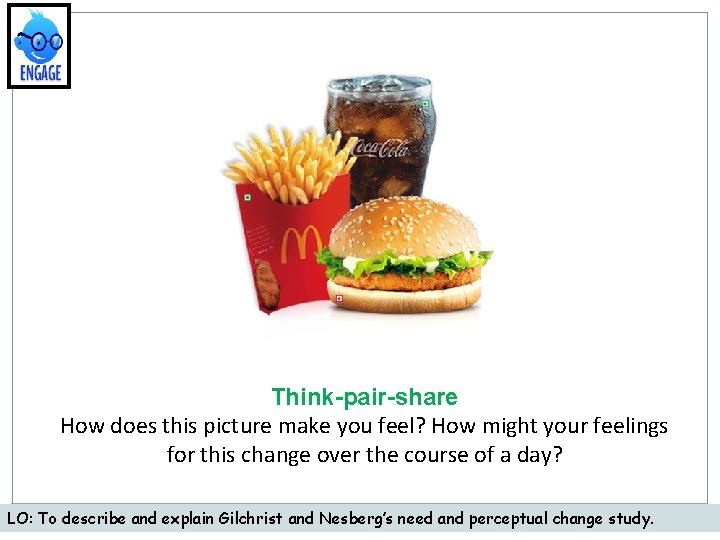
Think-pair-share How does this picture make you feel? How might your feelings for this change over the course of a day? LO: To describe and explain Gilchrist and Nesberg’s need and perceptual change study.
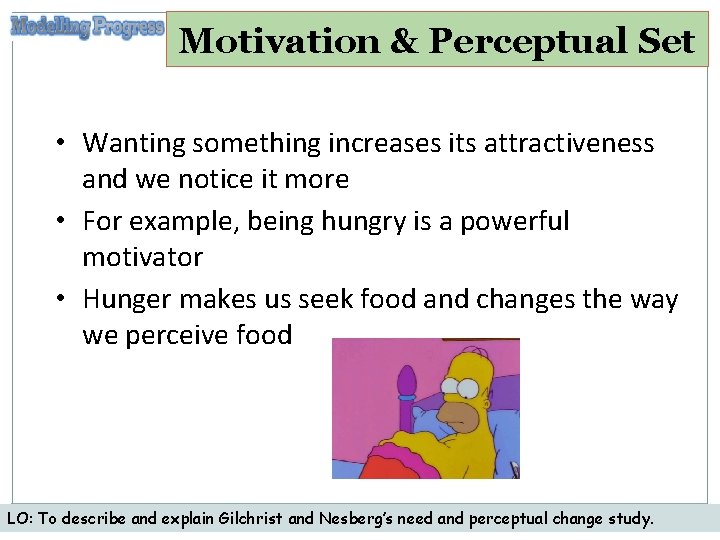
Factors affecting perception: Motivation • Remember Perceptual Set = the need to select what we are going to notice, choosing what is important and leaving out what is not • Your motivation can influence what you pay attention to and what you ignore • Motivation refers to the forces that ‘drive’ our behaviour – this can impact on our perceptual set LO: To describe and explain Gilchrist and Nesberg’s need and perceptual change study.
Factors affecting perception: Culture • Make a list of all of the things that motivate you. Would any of them affect how likely you are to notice something? I. e. your perceptual set LO: To describe and explain Gilchrist and Nesberg’s need and perceptual change study.
Motivation & Perceptual Set • Wanting something increases its attractiveness and we notice it more • For example, being hungry is a powerful motivator • Hunger makes us seek food and changes the way we perceive food LO: To describe and explain Gilchrist and Nesberg’s need and perceptual change study.
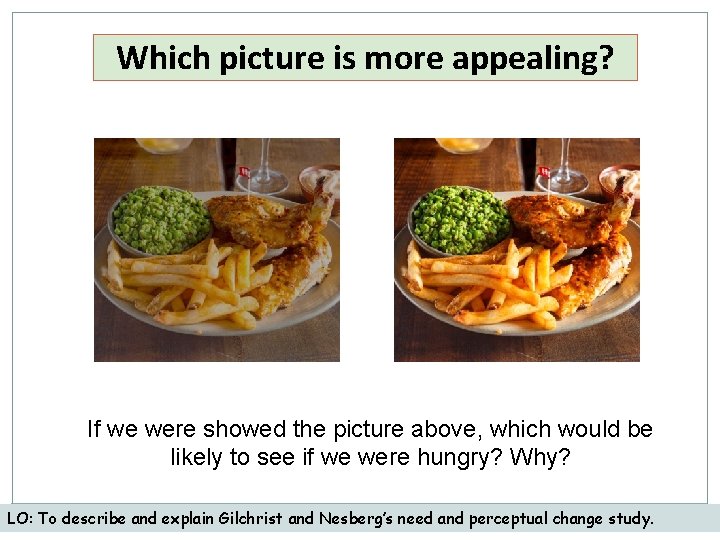
Which picture is more appealing? If we were showed the picture above, which would be likely to see if we were hungry? Why? LO: To describe and explain Gilchrist and Nesberg’s need and perceptual change study.
Let’s find out what they did and found. . . Gilchrist & Nesberg (1952) = Motivation & Perceptual Set This is a named study and you will need to know this in detail LO: To describe and explain Gilchrist and Nesberg’s need and perceptual change study.
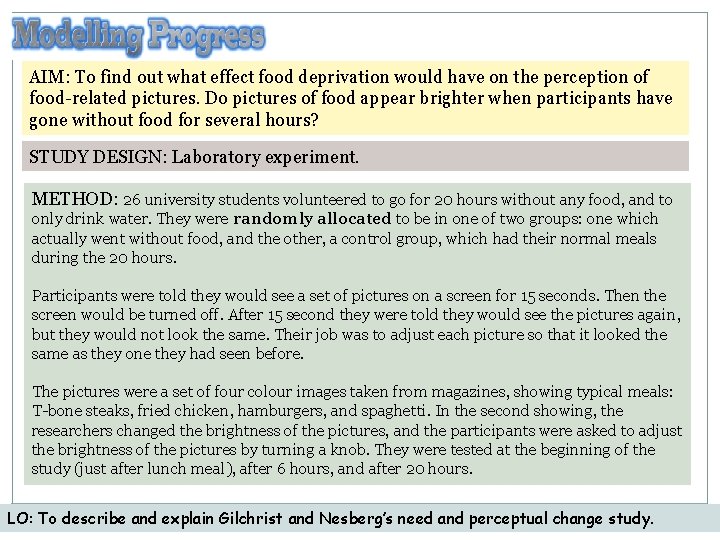
AIM: To find out what effect food deprivation would have on the perception of food-related pictures. Do pictures of food appear brighter when participants have gone without food for several hours? STUDY DESIGN: Laboratory experiment. METHOD: 26 university students volunteered to go for 20 hours without any food, and to only drink water. They were randomly allocated to be in one of two groups: one which actually went without food, and the other, a control group, which had their normal meals during the 20 hours. Participants were told they would see a set of pictures on a screen for 15 seconds. Then the screen would be turned off. After 15 second they were told they would see the pictures again, but they would not look the same. Their job was to adjust each picture so that it looked the same as they one they had seen before. The pictures were a set of four colour images taken from magazines, showing typical meals: T-bone steaks, fried chicken, hamburgers, and spaghetti. In the second showing, the researchers changed the brightness of the pictures, and the participants were asked to adjust the brightness of the pictures by turning a knob. They were tested at the beginning of the study (just after lunch meal), after 6 hours, and after 20 hours. LO: To describe and explain Gilchrist and Nesberg’s need and perceptual change study.
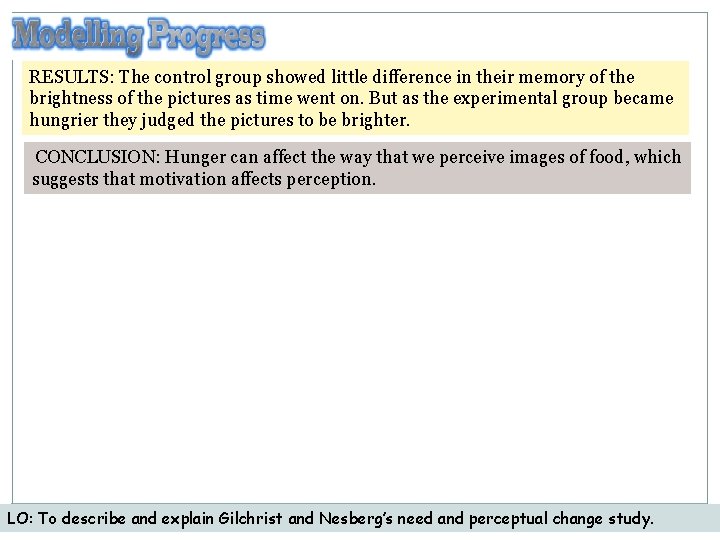
RESULTS: The control group showed little difference in their memory of the brightness of the pictures as time went on. But as the experimental group became hungrier they judged the pictures to be brighter. CONCLUSION: Hunger can affect the way that we perceive images of food, which suggests that motivation affects perception. LO: To describe and explain Gilchrist and Nesberg’s need and perceptual change study.
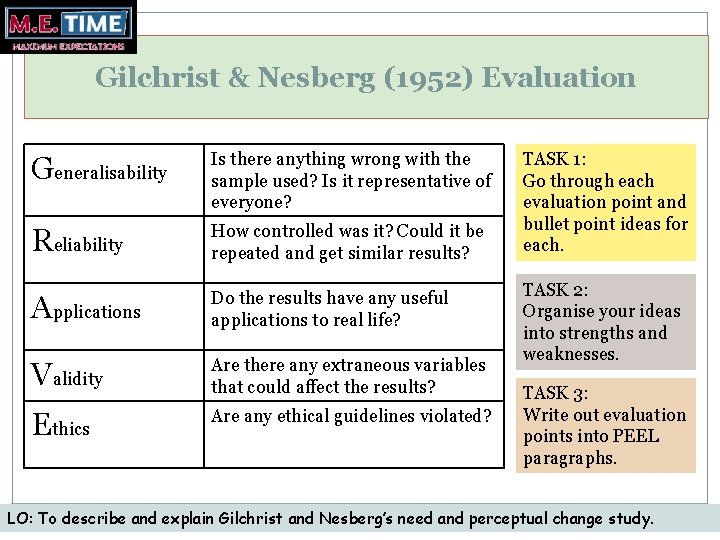
Gilchrist & Nesberg (1952) Evaluation Generalisability Is there anything wrong with the sample used? Is it representative of everyone? Reliability How controlled was it? Could it be repeated and get similar results? Applications Do the results have any useful applications to real life? Validity Are there any extraneous variables that could affect the results? Ethics Are any ethical guidelines violated? TASK 1: Go through each evaluation point and bullet point ideas for each. TASK 2: Organise your ideas into strengths and weaknesses. TASK 3: Write out evaluation points into PEEL paragraphs. LO: To describe and explain Gilchrist and Nesberg’s need and perceptual change study.
Complete your revision booklets for today’s lesson. LO: To describe and explain Gilchrist and Nesberg’s need and perceptual change study.