
01 WINTER Color Coding Template vs Abbreviations to
01 WINTER Color Coding. Template vs. Abbreviations to Teach Word Order King Mongkut’s University of Technology Thonburi http: //arts. kmutt. ac. th/crs/workshop. htm KMUTT Punjaporn Pojanapunya Wilaksana Srimavin
Is metalanguage needed? 02 ‘Many university modern language teachers bemoan the ‘fact’ that their students do not have any metalanguage’. … If students simply need metalinguistic knowledge in order to understand language classes because such metalanguage is in common use, one possible options is to change the way one teaches, and avoid using metalanguage. Such suggestions are, however, frequently met with blank looks, and after some reflection, the assertion that students need to learn metalanguage anyway, since many will go on to become teachers. The assumption that teachers need to have metalanguage goes unchallenged. ’ Alderson, J. C. (1997)

Is metalanguage needed? 03 Assumptions: Is metalanguage needed? Yes No Teach metalanguage (parts of speech)
Are metalingual terms needed? 04 “Writers tend to avoid using it a great deal when writing for low proficiency learners but the provision of glossaries of terms in most Pedagogic Grammar books bears testimony to a widely held view that some learner acquaintance with key terms is worthwhile. ” Fortune, A. (2005)
Are metalingual terms needed? Yes (Abbreviations) No (Colors) 05
Purpose 06 To study the effectiveness of using color codes and abbreviations on word ordering in sentences
07 Methods Subjects 61 undergraduates at (KMUTT) Course: Fundamental English III (LNG 103) Faculty: Sciences English proficiency: Average 2 groups: Abbreviations Color codes (ABB) (COL) 31 subjects 20 subjects
Instruments and Procedures 08 Step 1: Pre-test: Receptive and Productive skills (Subjects’ use of Language) Step 2: Tasks 1 - 3 Step 3: Quiz 1: Receptive and Productive skills (Subjects’ use of Metalanguage: POS) Step 4: Tasks 4 - 6 Step 5: Quiz 2 Step 6: Tasks 7 – 9 Step 7: Quiz 3 Step 8: Post-test
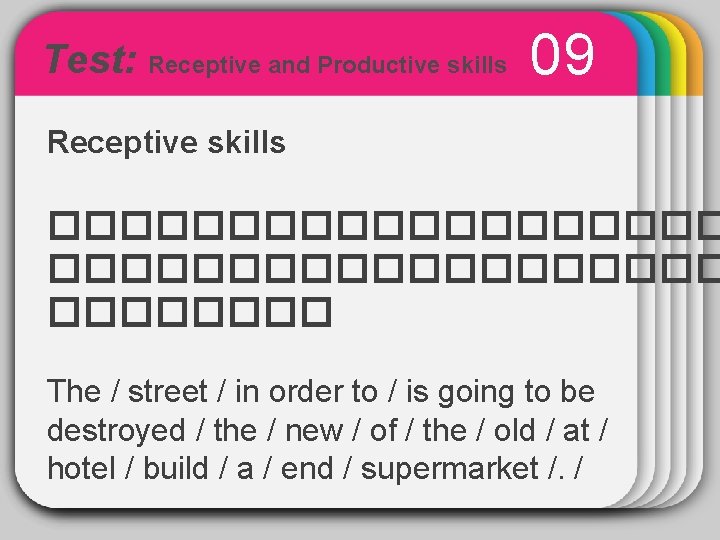
Test: Receptive and Productive skills 09 WINTER Receptive skills Template ������������������� The / street / in order to / is going to be destroyed / the / new / of / the / old / at / hotel / build / a / end / supermarket /. /
Test: Receptive and Productive skills 10 WINTER Productive skills Template ��������������������
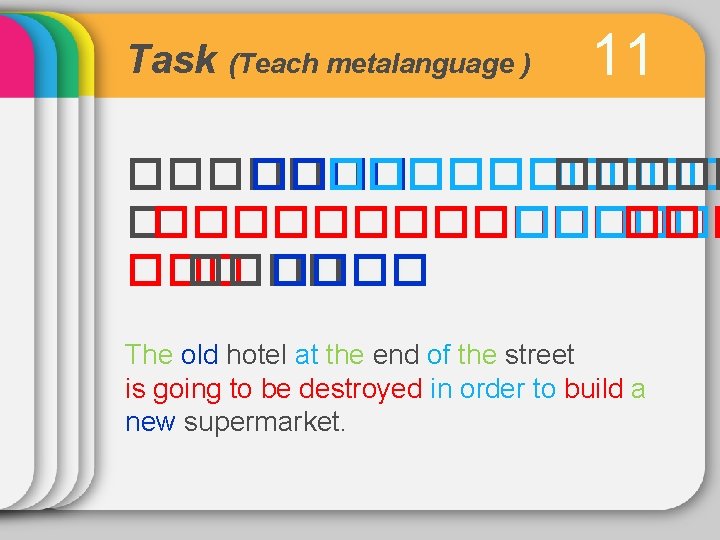
Task (Teach metalanguage ) 11 ������ ����������� �� ���� The old hotel at the end of the street is going to be destroyed in order to build a new supermarket.
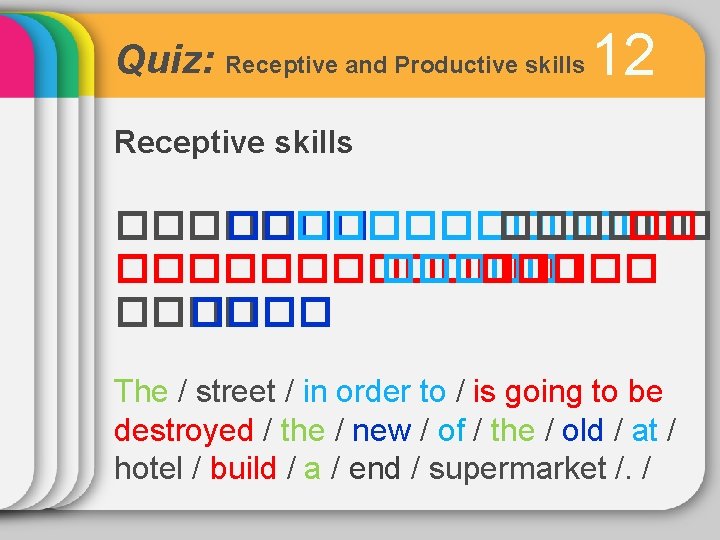
Quiz: Receptive and Productive skills 12 Receptive skills ������ ������ �� ������� ���� The / street / in order to / is going to be destroyed / the / new / of / the / old / at / hotel / build / a / end / supermarket /. /
Quiz: Receptive and Productive skills 13 Productive skills ����������������� The old hotel at the end of the street is going to be destroyed in order to build a new supermarket.
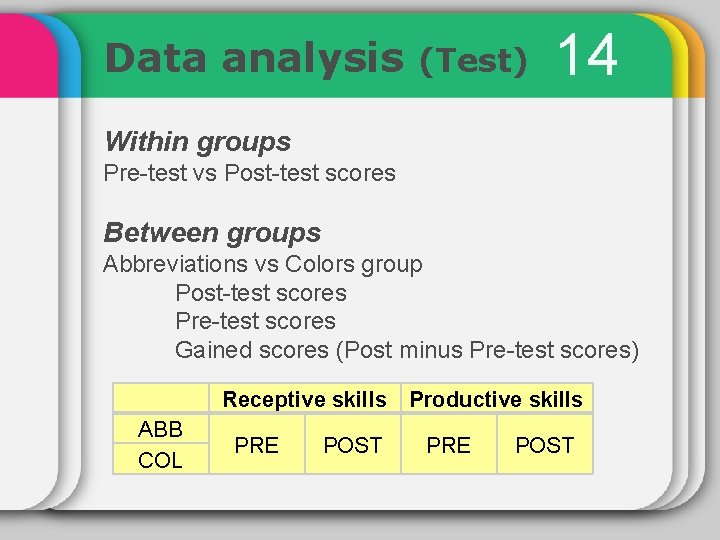
Data analysis (Test) 14 Within groups Pre-test vs Post-test scores Between groups Abbreviations vs Colors group Post-test scores Pre-test scores Gained scores (Post minus Pre-test scores) Receptive skills ABB COL PRE POST Productive skills PRE POST
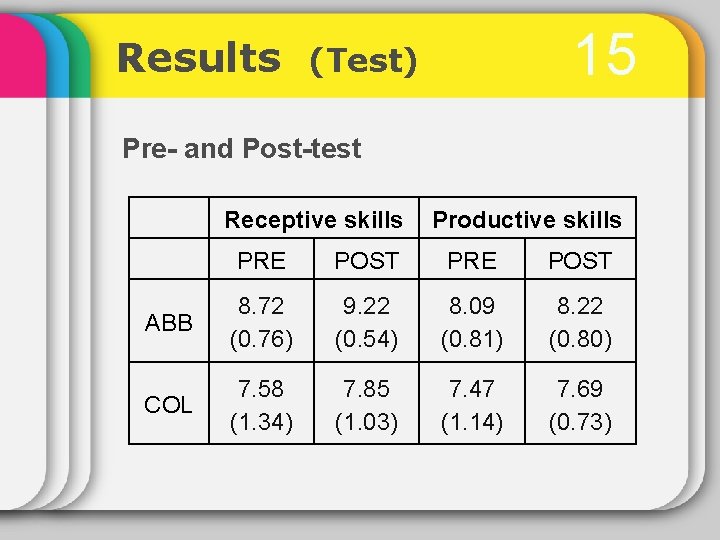
Results 15 (Test) Pre- and Post-test Receptive skills Productive skills PRE POST ABB 8. 72 (0. 76) 9. 22 (0. 54) 8. 09 (0. 81) 8. 22 (0. 80) COL 7. 58 (1. 34) 7. 85 (1. 03) 7. 47 (1. 14) 7. 69 (0. 73)
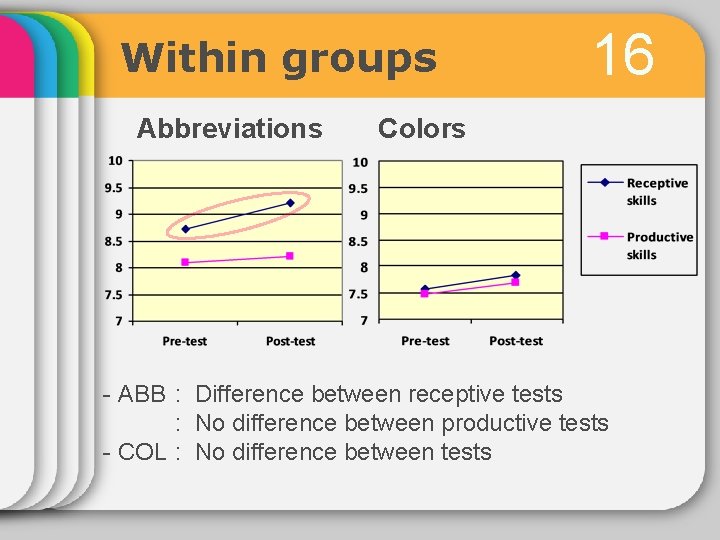
Within groups Abbreviations 16 Colors - ABB : Difference between receptive tests : No difference between productive tests - COL : No difference between tests
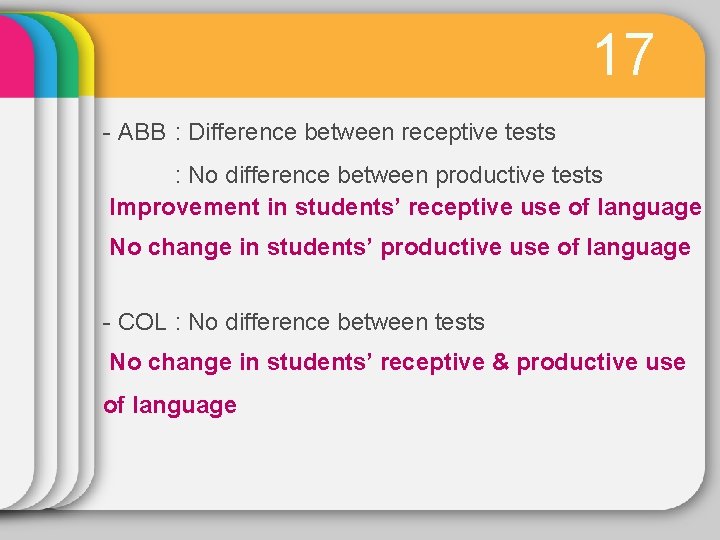
17 - ABB : Difference between receptive tests : No difference between productive tests Improvement in students’ receptive use of language No change in students’ productive use of language - COL : No difference between tests No change in students’ receptive & productive use of language
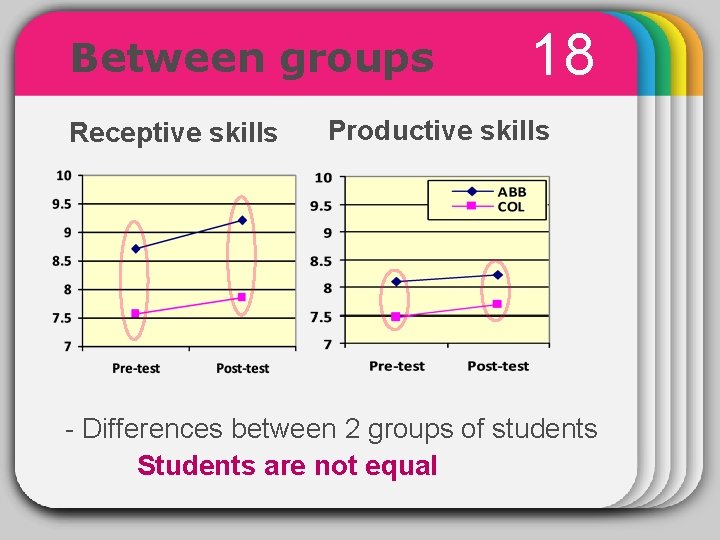
Between groups 18 WINTER Receptive skills Productive skills Template - Differences between 2 groups of students Students are not equal
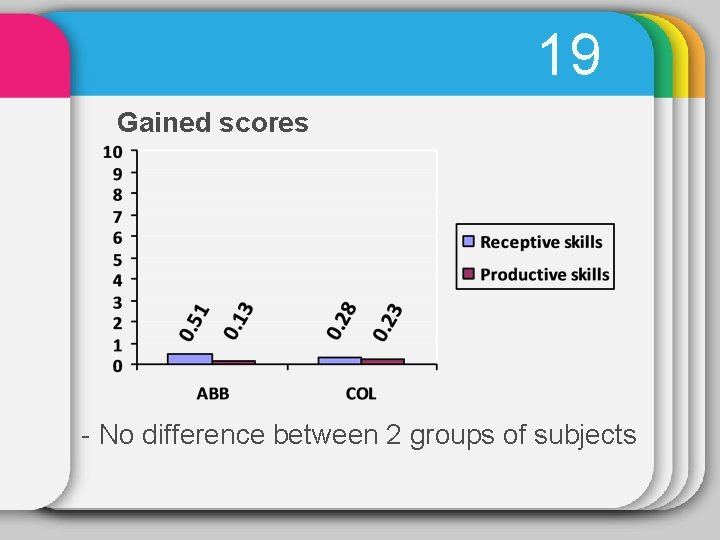
19 Gained scores - No difference between 2 groups of subjects
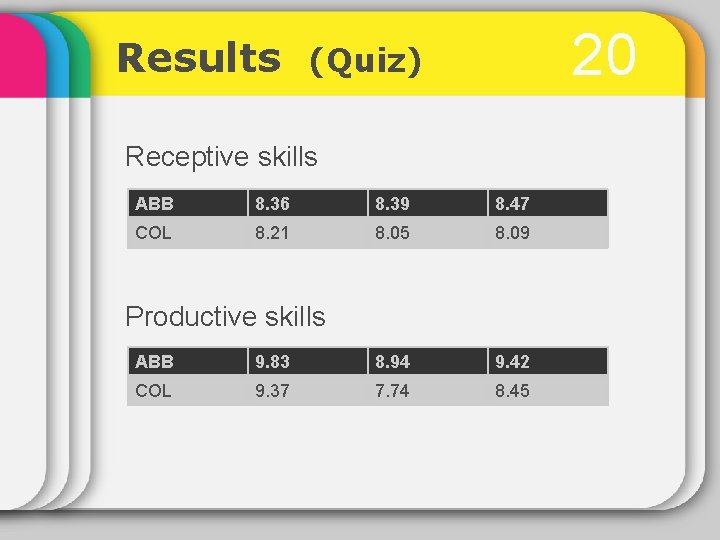
Results 20 (Quiz) Receptive skills ABB 8. 36 8. 39 8. 47 COL 8. 21 8. 05 8. 09 Productive skills ABB 9. 83 8. 94 9. 42 COL 9. 37 7. 74 8. 45
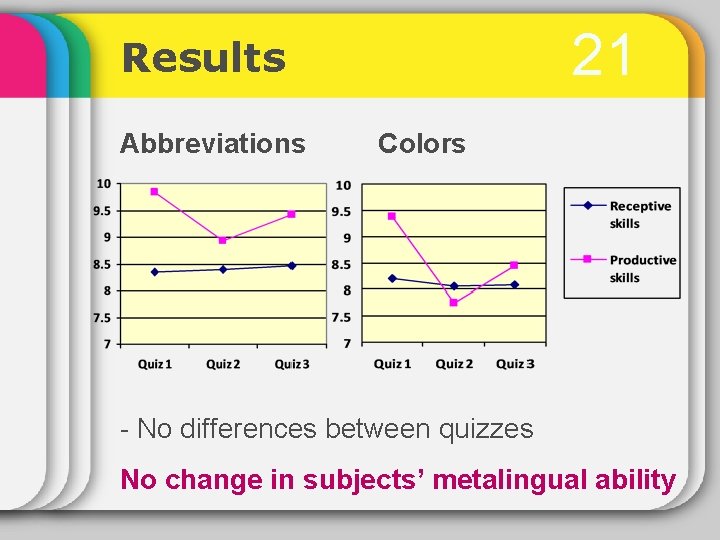
21 Results Abbreviations Colors - No differences between quizzes No change in subjects’ metalingual ability
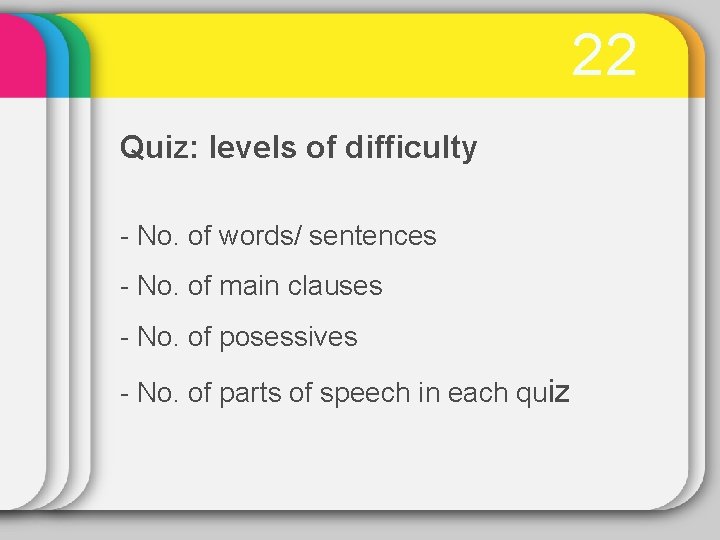
22 Quiz: levels of difficulty - No. of words/ sentences - No. of main clauses - No. of posessives - No. of parts of speech in each quiz
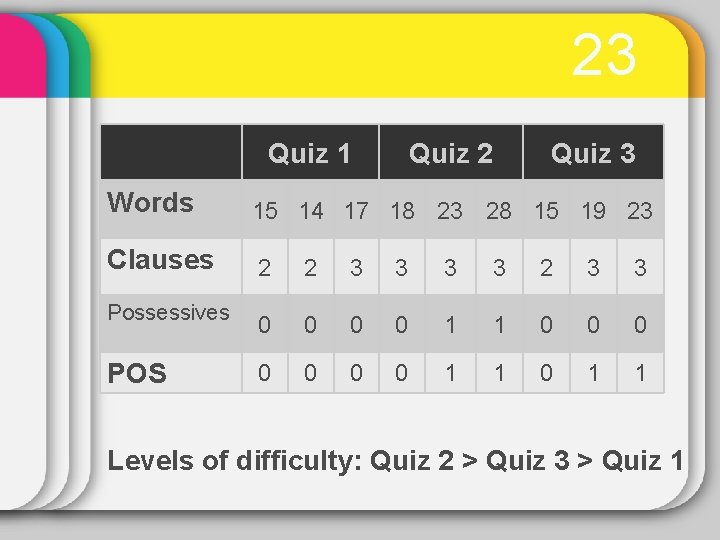
23 Quiz 1 Quiz 2 Quiz 3 Words 15 14 17 18 23 28 15 19 23 Clauses 2 2 3 3 Possessives 0 0 1 1 0 0 0 POS 0 0 1 1 Levels of difficulty: Quiz 2 > Quiz 3 > Quiz 1
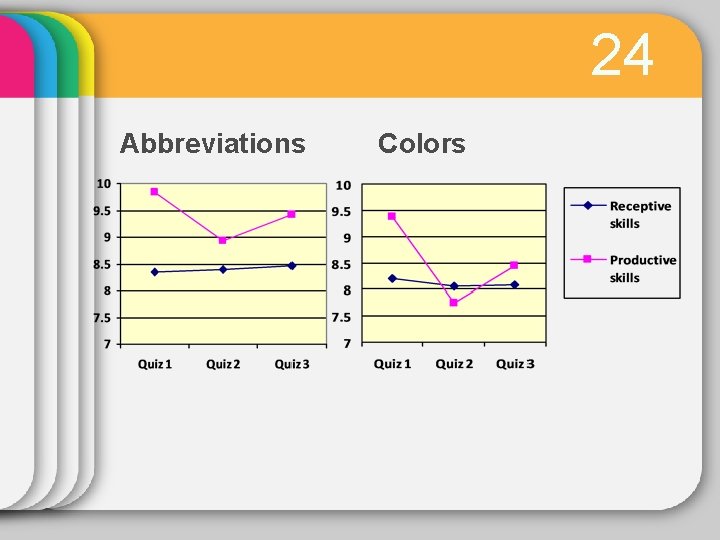
24 Abbreviations Colors
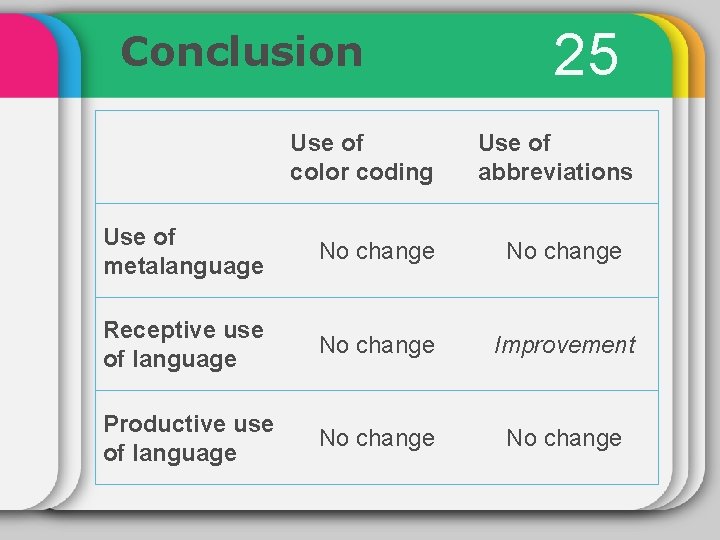
Conclusion Use of color coding 25 Use of abbreviations Use of metalanguage No change Receptive use of language No change Improvement Productive use of language No change
Discussion 26 • Problems in research methodology • The relationship between metalanguage and language learning
27 Problems in research methodology - Timing - Subject selection
28 Timing “…massed practice can be more effective than distributed practice in classroom learning, especially in the case of second/ foreign languages. ” Serrano, R. and Munoz C. (2007: 319)
29 WINTER Subject selection Template - Hoped for equal groups - Differences in language proficiency - Can be controlled through statistics (gained scores) - Differences in motivation and attentiveness
30 The relationship between metalanguage and language learning “The relationship between metalinguistic knowledge and language proficiency is weak. Metalinguistic knowledge and language proficiency appear to constitute two separate factors of linguistic ability” Alderson et al. (1997: 118)
31 Does metalanguage help with language performance? - No changes in use of metalanguage - Nearly no changes in use of language No relationship identifiable Should metalanguage be taught through abbreviations (terminology) or color coding? - No changes for color coding - Small change for abbreviations Grammatical terminology may be preferable Students’ familiarity with terms
Contact 32 Punjaporn Pojanapunya punjaporn. poj@kmutt. ac. th Wilaksana Srimavin Wilaksana. sri@kmutt. ac. th http: //arts. kmutt. ac. th/crs/workshop. htm
- Slides: 32