
001489 Translation and Interpretation Components of Independent Study

- Slides: 20
001489 Translation and Interpretation
Components of Independent Study � Rationale and Introduction � Literature Review � Methodology / Text Analysis (for translation and interpretation section only) � Data Analysis � Conclusion
Organization 1. Translation - Translation work with analysis of the translated text - you don’t need to translate the whole text, just enough of it to get the whole picture and sufficient data for analysis 2. Comparative Study - Analysis of chosen translated text(s) using certain conceptual frameworks.
Finding Topic � 1. Pick appropriate text › well-written/translated , clear, interesting �E. g. fictions, plays, documentaries, films or animations � 2. Pick an issue you’d like to study about › Translational phenomena �E. g. metaphor translation, pun translation, jargon translation, cultural translation, poetry translation › Employing certain frameworks to help translate/ analyze the text �E. g. employing Skopos/ Dynamic Equivalence linguistic frameworks e. g. theories in semantics, pragmatics, sociolinguistics and discourse analysis
Tips � Choose a text that you are familiar with. › Having read it/ about it before or having background on the subject matter � Read A LOT of previous studies Know more abt the framework, methodology and data analysis Be able to adapt the frameworks/methods employed to your own study
Choosing Source Text � Literary works › Novels, plays, poetry � Documentary writing � Manuals, Instructions, Regulations � Ads � Textbooks � Audiovisual media › Film, TV show, documentaries
Set Up Good RQs � RQs = crucial part of the proposal convince your advisor that your topic is coherent, interesting and feasible. › Help outline the overall paper = what you must find out, eventually leading to conclusions › Conclusions always come back to answer RQs
Choosing Frameworks � For translation work › Translation approach of the overall text �Semantic/Communicative approach �Skopos › Equivalence �Formal/Dynamic equivalence �Textual/Pragmatic equivalence › Translation Procedure �Componential Analysis
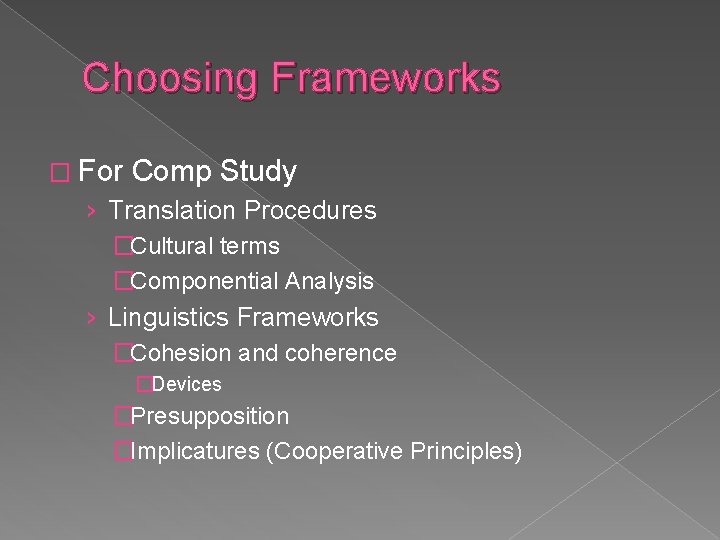
Choosing Frameworks � For Comp Study › Translation Procedures �Cultural terms �Componential Analysis › Linguistics Frameworks �Cohesion and coherence �Devices �Presupposition �Implicatures (Cooperative Principles)
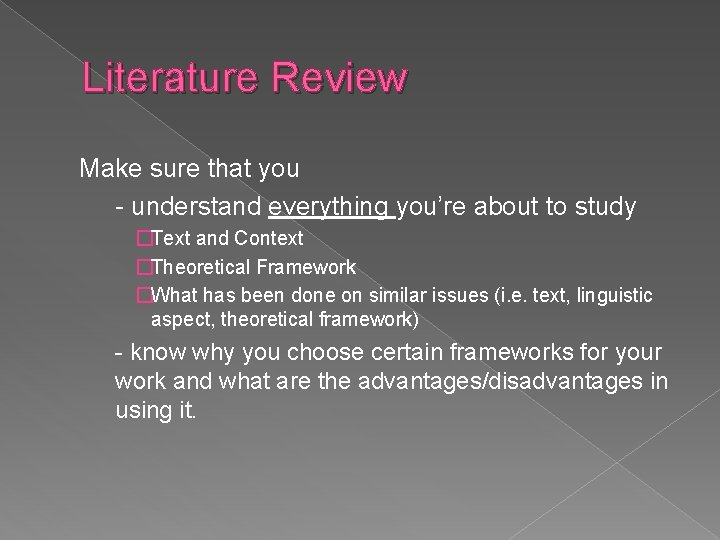
Literature Review Make sure that you - understand everything you’re about to study �Text and Context �Theoretical Framework �What has been done on similar issues (i. e. text, linguistic aspect, theoretical framework) - know why you choose certain frameworks for your work and what are the advantages/disadvantages in using it.
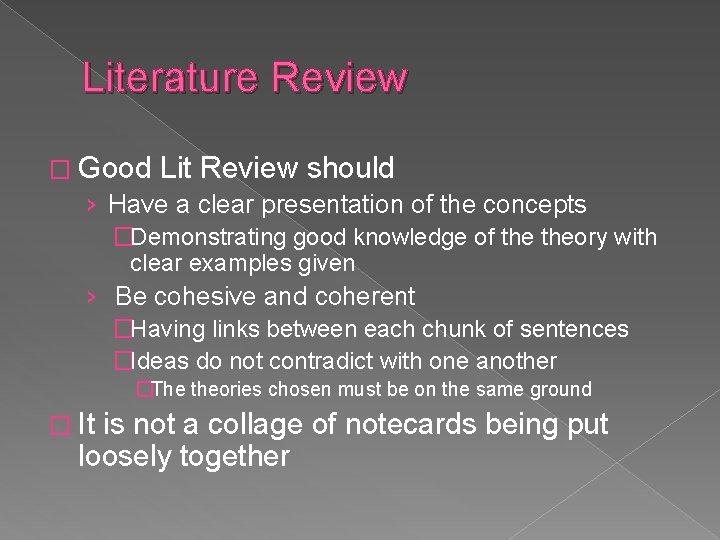
Literature Review � Good Lit Review should › Have a clear presentation of the concepts �Demonstrating good knowledge of theory with clear examples given › Be cohesive and coherent �Having links between each chunk of sentences �Ideas do not contradict with one another �The theories chosen must be on the same ground � It is not a collage of notecards being put loosely together
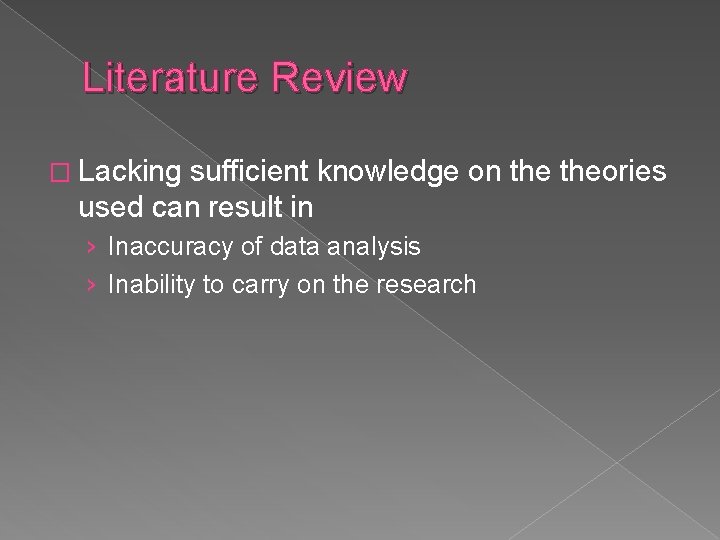
Literature Review � Lacking sufficient knowledge on theories used can result in › Inaccuracy of data analysis › Inability to carry on the research
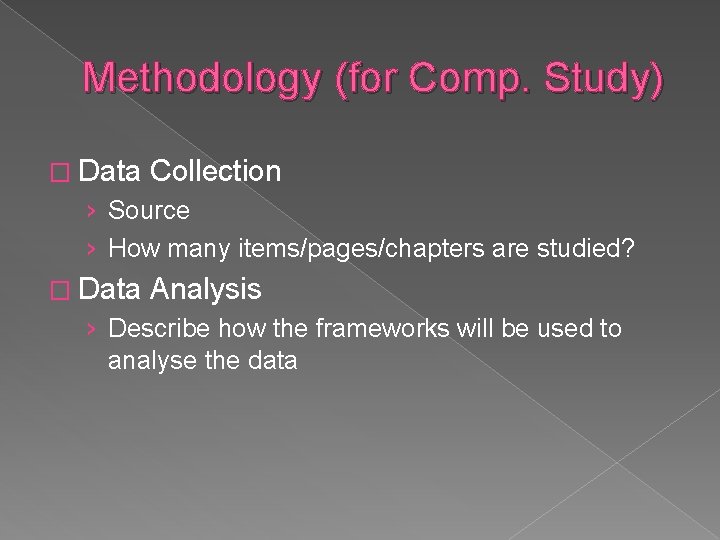
Methodology (for Comp. Study) � Data Collection › Source › How many items/pages/chapters are studied? � Data Analysis › Describe how the frameworks will be used to analyse the data
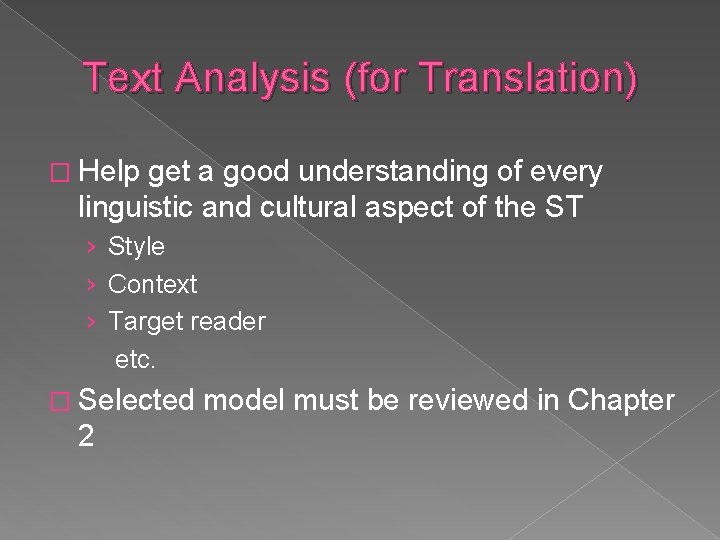
Text Analysis (for Translation) � Help get a good understanding of every linguistic and cultural aspect of the ST › Style › Context › Target reader etc. � Selected 2 model must be reviewed in Chapter
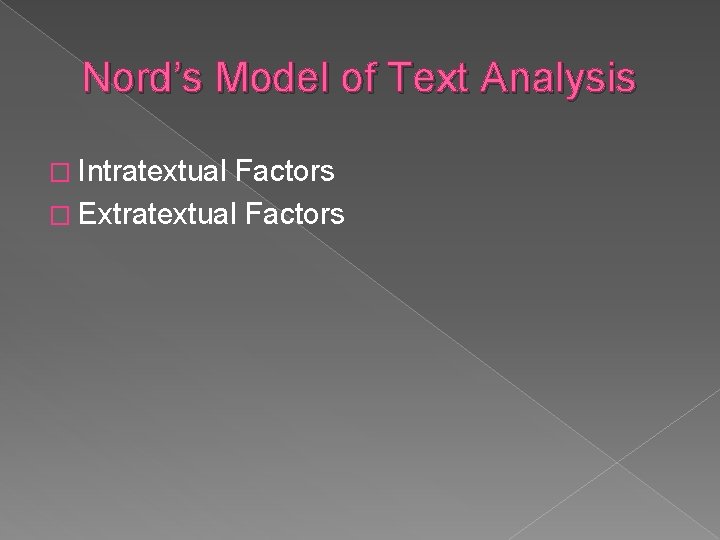
Nord’s Model of Text Analysis � Intratextual Factors � Extratextual Factors
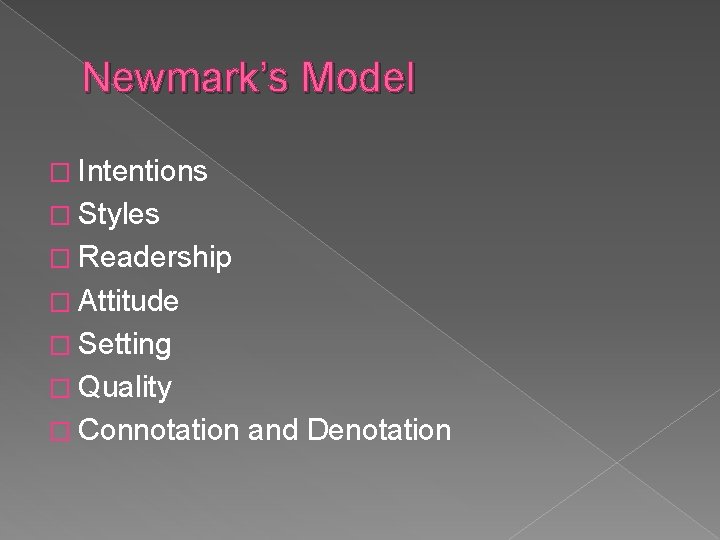
Newmark’s Model � Intentions � Styles � Readership � Attitude � Setting � Quality � Connotation and Denotation
Data Analysis � Close relationship w/ Lit. Review � For translation work, this chapter might include translator’s comment › Problem-solving
Communication Project � Presentation of the findings in a communicative channwl
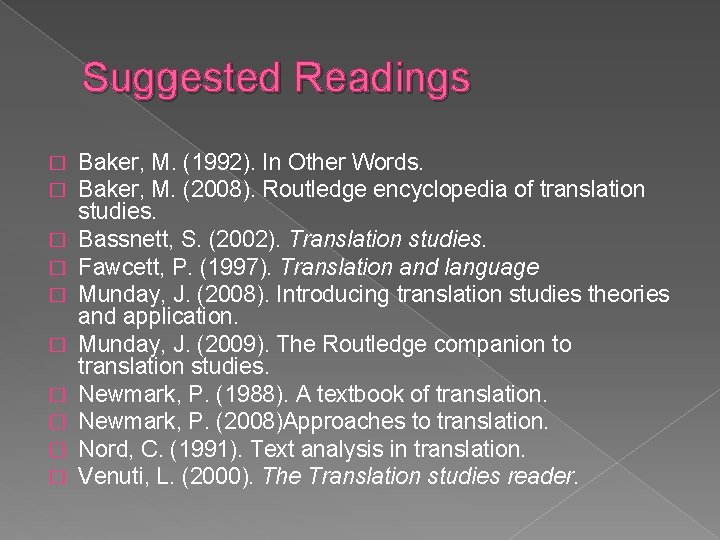
Suggested Readings � � � � � Baker, M. (1992). In Other Words. Baker, M. (2008). Routledge encyclopedia of translation studies. Bassnett, S. (2002). Translation studies. Fawcett, P. (1997). Translation and language Munday, J. (2008). Introducing translation studies theories and application. Munday, J. (2009). The Routledge companion to translation studies. Newmark, P. (1988). A textbook of translation. Newmark, P. (2008)Approaches to translation. Nord, C. (1991). Text analysis in translation. Venuti, L. (2000). The Translation studies reader.