
0 Introduction to Social Choice Lirong Xia Fall


- Slides: 45
0
Introduction to Social Choice Lirong Xia Fall, 2016
Keep in mind ØGood science • What question does it answer? ØGood engineering • What problem does it solve? 2
Last class ØHow to model agents’ preferences? ØOrder theory • linear orders • weak orders • partial orders ØUtility theory • preferences over lotteries • risk attitudes: aversion, neutrality, seeking 3
Today ØQ: What problem does it solve? ØA: Aggregating agents’ preferences and make a joint decision by voting 4
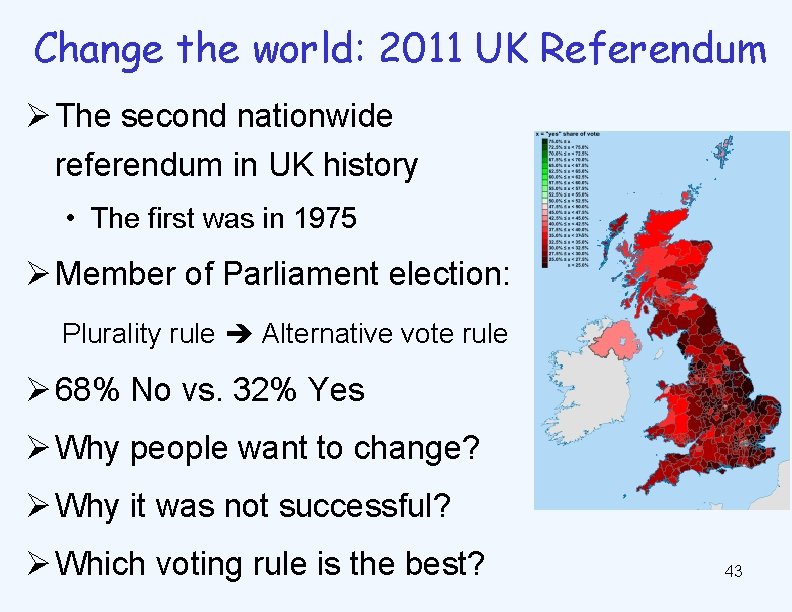
Change the world: 2011 UK Referendum Ø The second nationwide referendum in UK history • The first was in 1975 Ø Member of Parliament election: Plurality rule Alternative vote rule Ø 68% No vs. 32% Yes Ø In 10/440 districts more voters said yes • 6 in London, Oxford, Cambridge, Edinburgh Central, and Glasgow Kelvin Ø Why change? Ø Why failed? Ø Which voting rule is the best? 5
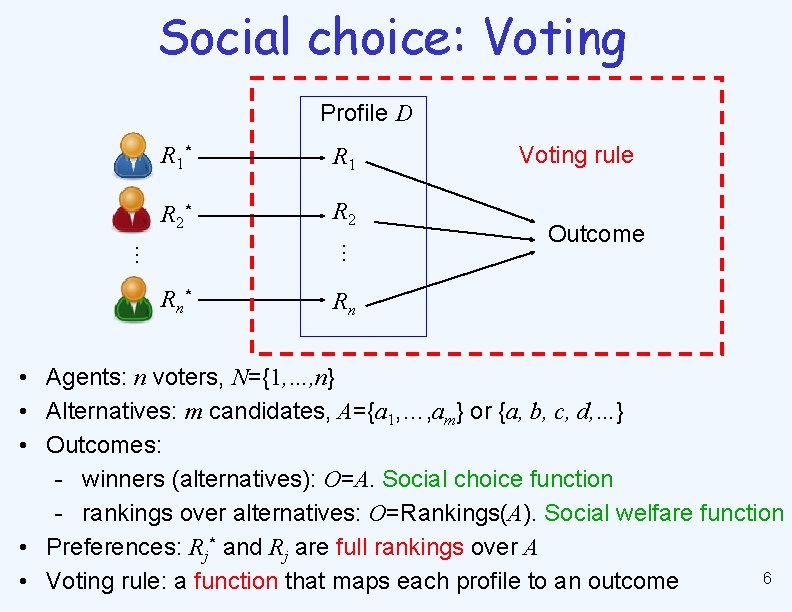
Social choice: Voting Profile D R 1 R 2* R 2 R n* Rn … … R 1* Voting rule Outcome • Agents: n voters, N={1, …, n} • Alternatives: m candidates, A={a 1, …, am} or {a, b, c, d, …} • Outcomes: - winners (alternatives): O=A. Social choice function - rankings over alternatives: O=Rankings(A). Social welfare function • Preferences: Rj* and Rj are full rankings over A 6 • Voting rule: a function that maps each profile to an outcome
Popular voting rules (a. k. a. what people have done in the past two centuries) 7
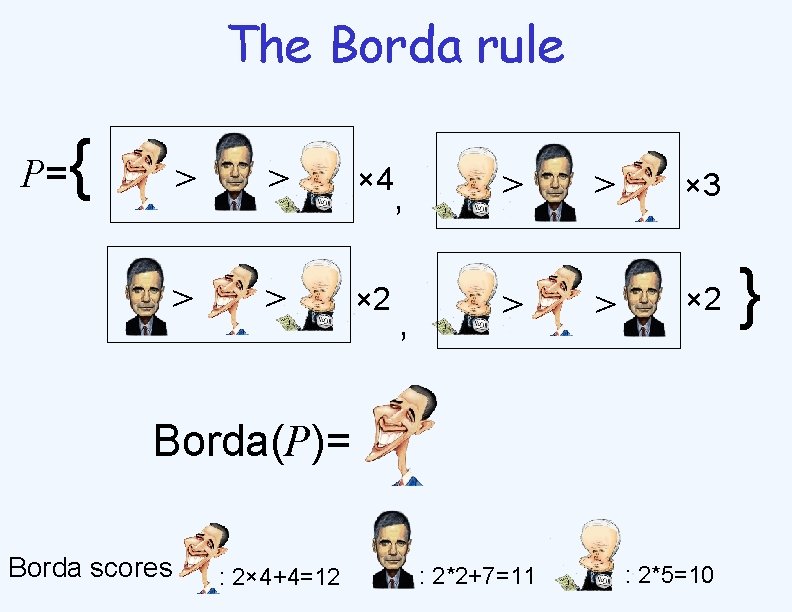
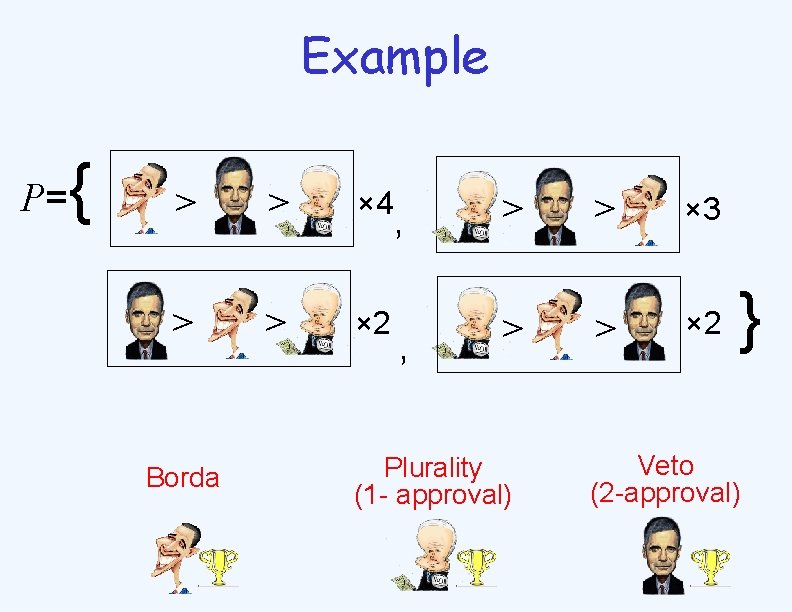
The Borda rule P= { > > × 4 > > × 2 , , > > × 3 > > × 2 Borda(P)= Borda scores : 2× 4+4=12 : 2*2+7=11 : 2*5=10 }
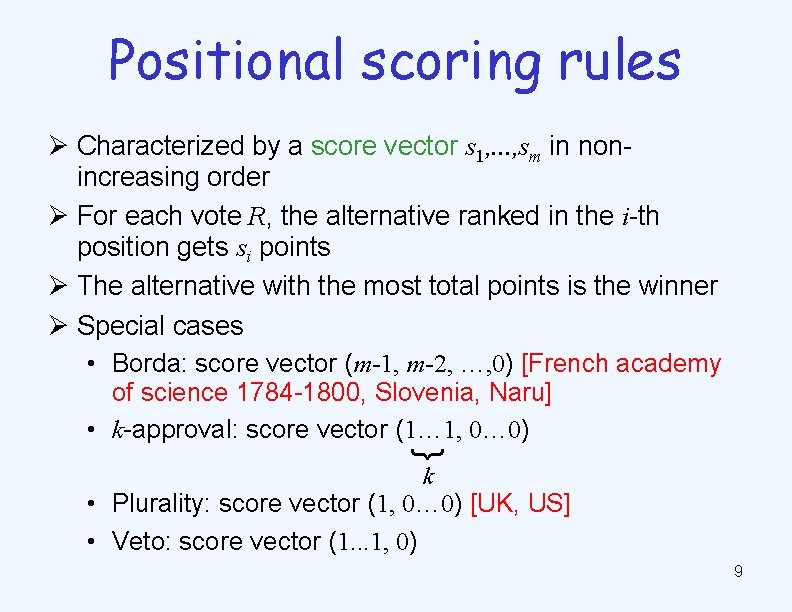
Positional scoring rules Ø Characterized by a score vector s 1, . . . , sm in nonincreasing order Ø For each vote R, the alternative ranked in the i-th position gets si points Ø The alternative with the most total points is the winner Ø Special cases • Borda: score vector (m-1, m-2, …, 0) [French academy of science 1784 -1800, Slovenia, Naru] • k-approval: score vector (1… 1, 0… 0) } k • Plurality: score vector (1, 0… 0) [UK, US] • Veto: score vector (1. . . 1, 0) 9
Example P= { > > × 4 > > × 2 Borda , , > > × 3 > > × 2 Plurality (1 - approval) } Veto (2 -approval)
Plurality with runoff Ø The election has two rounds • First round, all alternatives except the two with the highest plurality scores drop out • Second round, the alternative preferred by more voters wins Ø [used in France, Iran, North Carolina State] 11
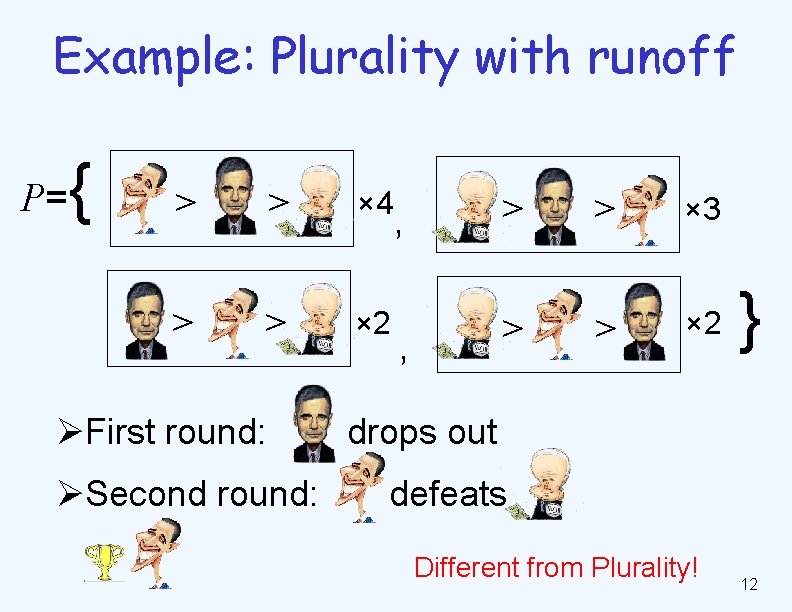
Example: Plurality with runoff P= { > > × 4 > > × 2 ØFirst round: ØSecond round: , , > > × 3 > > × 2 } drops out defeats Different from Plurality! 12
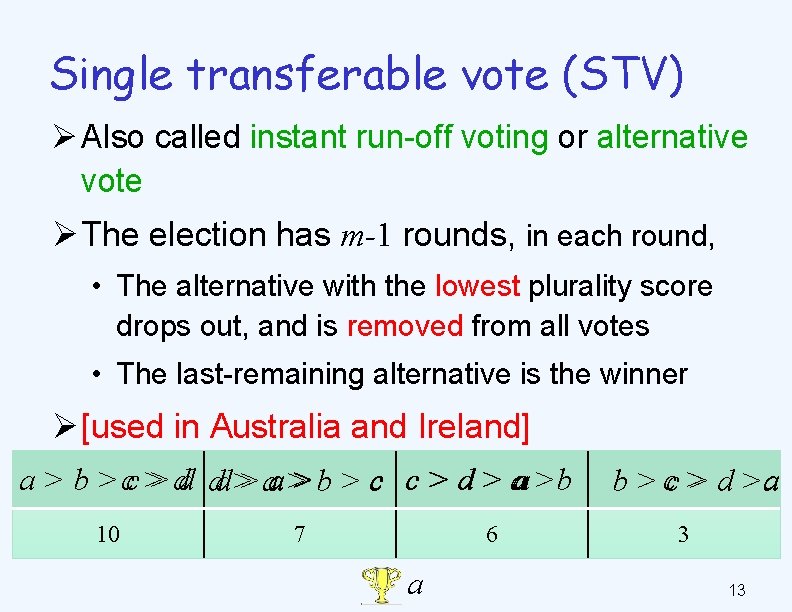
Single transferable vote (STV) Ø Also called instant run-off voting or alternative vote Ø The election has m-1 rounds, in each round, • The alternative with the lowest plurality score drops out, and is removed from all votes • The last-remaining alternative is the winner Ø [used in Australia and Ireland] a > b > cc > > dd dd >> aa >> b > c c > d > aa >b 10 7 6 a a b > c > d >a 3 13
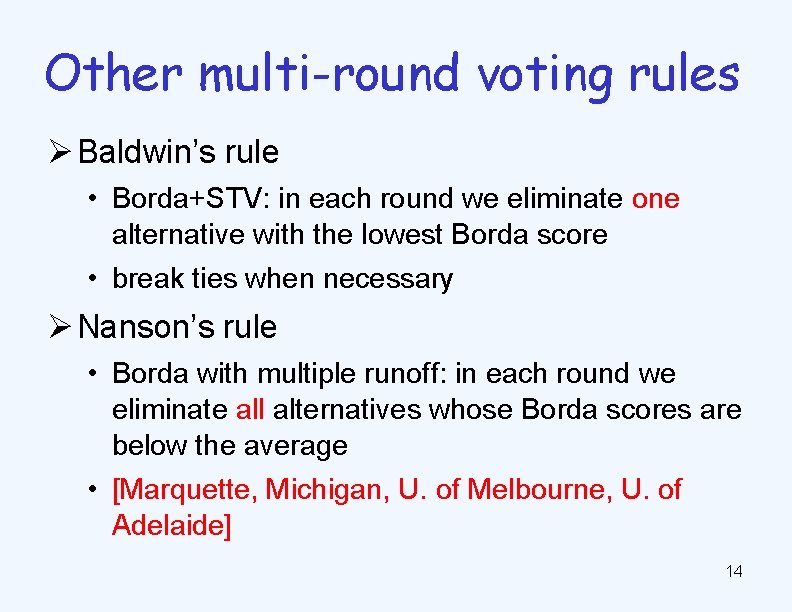
Other multi-round voting rules Ø Baldwin’s rule • Borda+STV: in each round we eliminate one alternative with the lowest Borda score • break ties when necessary Ø Nanson’s rule • Borda with multiple runoff: in each round we eliminate all alternatives whose Borda scores are below the average • [Marquette, Michigan, U. of Melbourne, U. of Adelaide] 14
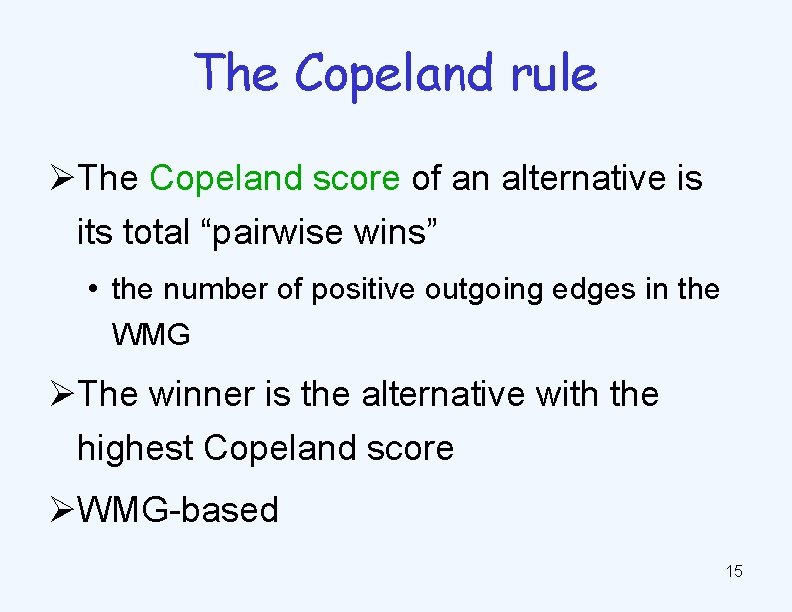
The Copeland rule ØThe Copeland score of an alternative is its total “pairwise wins” • the number of positive outgoing edges in the WMG ØThe winner is the alternative with the highest Copeland score ØWMG-based 15
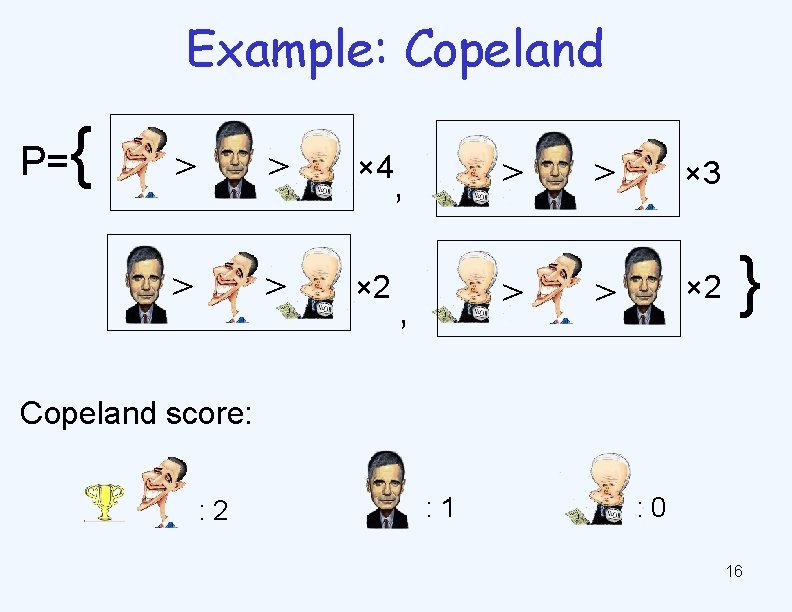
Example: Copeland P= { > > × 4 > > × 2 , , > > × 3 > > × 2 } Copeland score: : 2 : 1 : 0 16
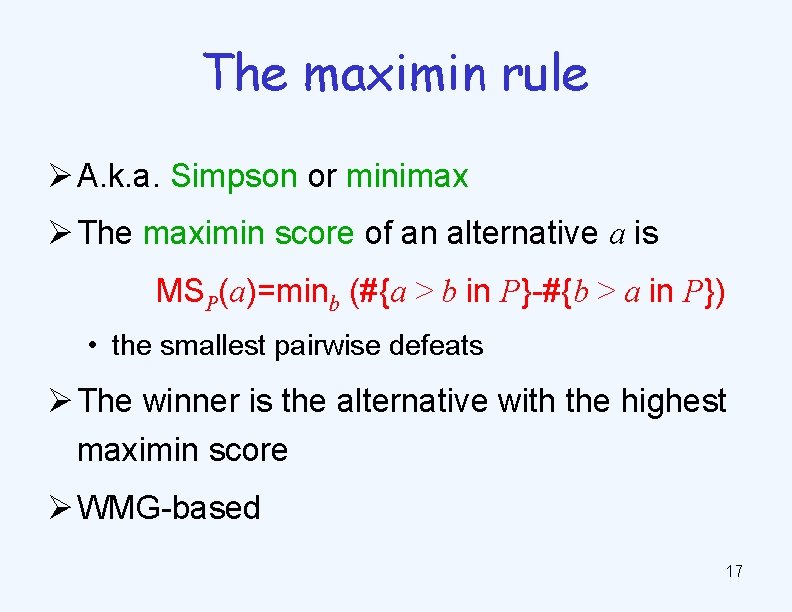
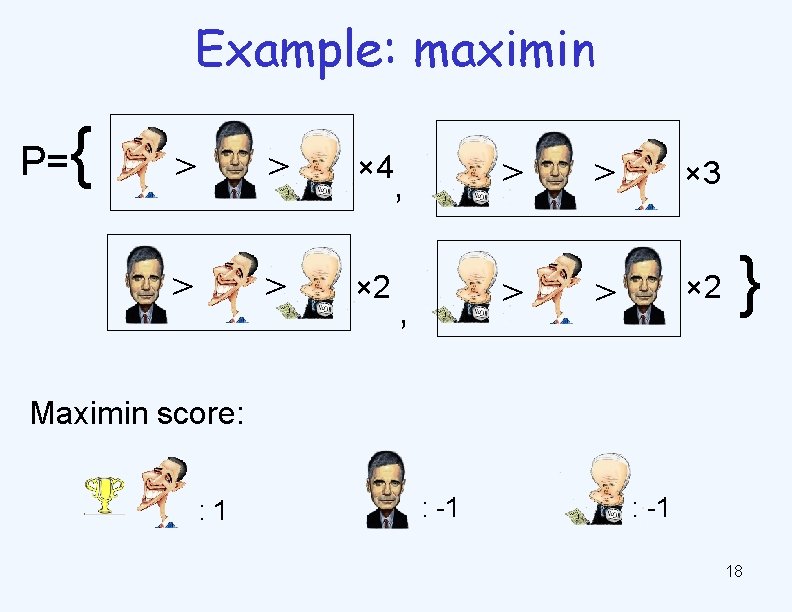
The maximin rule Ø A. k. a. Simpson or minimax Ø The maximin score of an alternative a is MSP(a)=minb (#{a > b in P}-#{b > a in P}) • the smallest pairwise defeats Ø The winner is the alternative with the highest maximin score Ø WMG-based 17
Example: maximin P= { > > × 4 > > × 2 , , > > × 3 > > × 2 } Maximin score: : 1 : -1 18
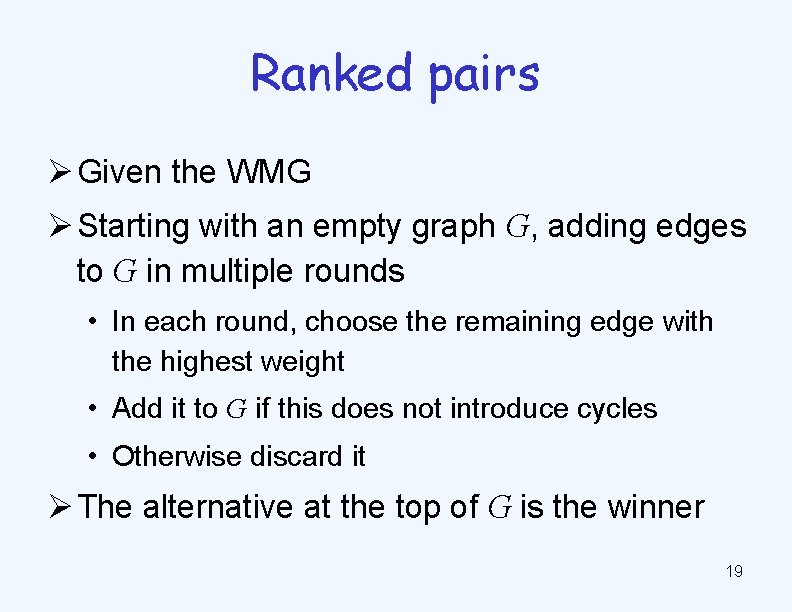
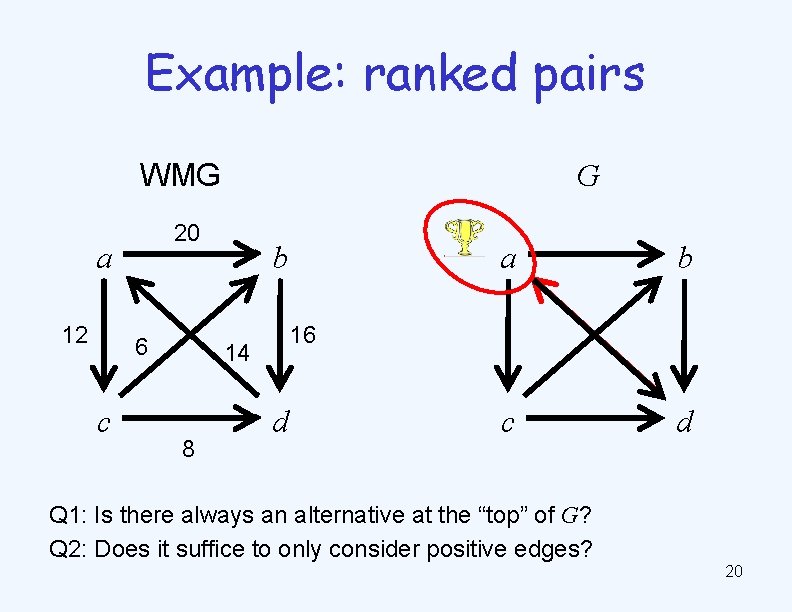
Ranked pairs Ø Given the WMG Ø Starting with an empty graph G, adding edges to G in multiple rounds • In each round, choose the remaining edge with the highest weight • Add it to G if this does not introduce cycles • Otherwise discard it Ø The alternative at the top of G is the winner 19
Example: ranked pairs WMG 20 a 12 6 c G b b c d 16 14 8 a d Q 1: Is there always an alternative at the “top” of G? Q 2: Does it suffice to only consider positive edges? 20
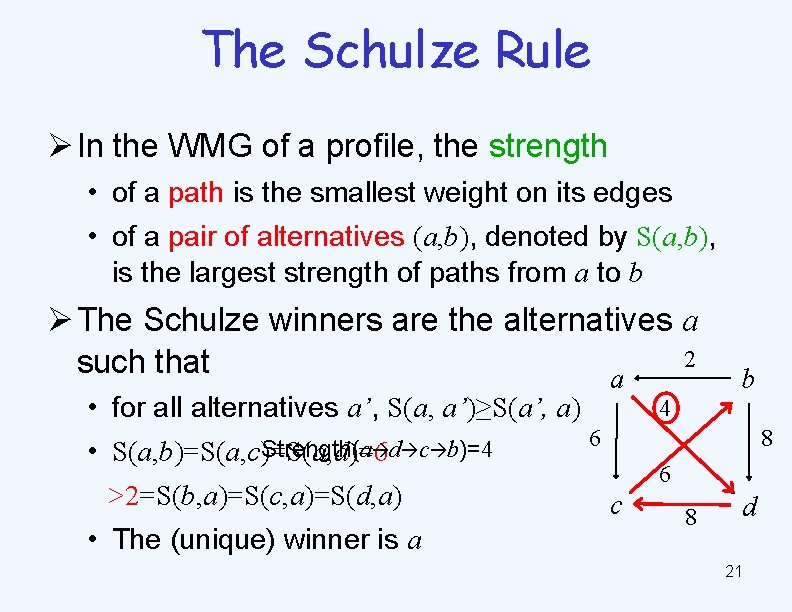
The Schulze Rule Ø In the WMG of a profile, the strength • of a path is the smallest weight on its edges • of a pair of alternatives (a, b), denoted by S(a, b), is the largest strength of paths from a to b Ø The Schulze winners are the alternatives a 2 such that a • for all alternatives a’, S(a, a’)≥S(a’, a) 6 Strength(a d c b)=4 • S(a, b)=S(a, c)=S(a, d)=6 >2=S(b, a)=S(c, a)=S(d, a) c • The (unique) winner is a b 4 8 6 8 d 21
Ranked pairs and Schulze Ø Ranked pairs [Tideman 1987] and Schulze [Schulze 1997] • Both satisfy anonymity, Condorcet consistency, monotonicity, immunity to clones, etc • Neither satisfy participation and consistency (these are not compatible with Condorcet consistency) Ø Schulze rule has been used in elections at Wikimedia Foundation, the Pirate Party of Sweden and Germany, the Debian project, and the Gento Project 22
The Bucklin Rule Ø An alternative a’s Bucklin score • smallest k such that for the majority of agents, a is ranked within top k ØSimplified Bucklin • Winners are the agents with the smallest Bucklin score 23
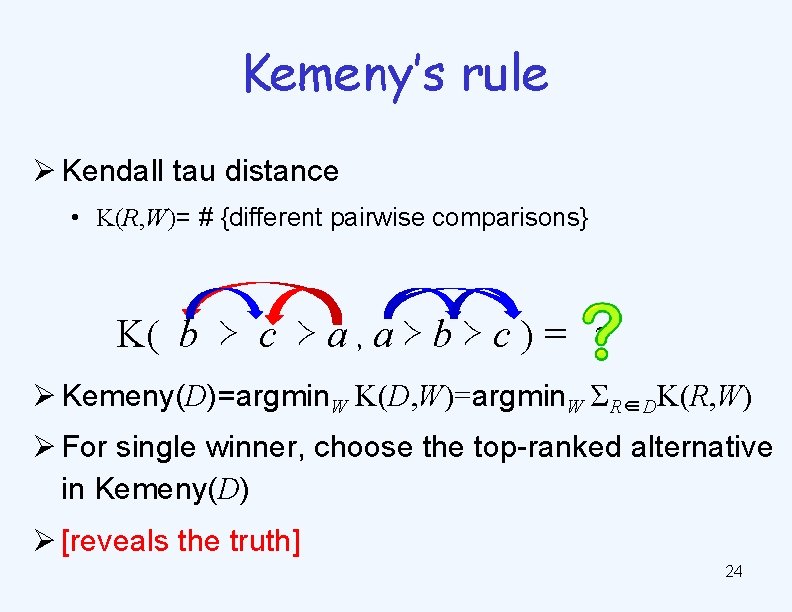
Kemeny’s rule Ø Kendall tau distance • K(R, W)= # {different pairwise comparisons} K( b ≻ c ≻ a , a ≻ b ≻ c ) = 21 Ø Kemeny(D)=argmin. W K(D, W)=argmin. W ΣR∈DK(R, W) Ø For single winner, choose the top-ranked alternative in Kemeny(D) Ø [reveals the truth] 24
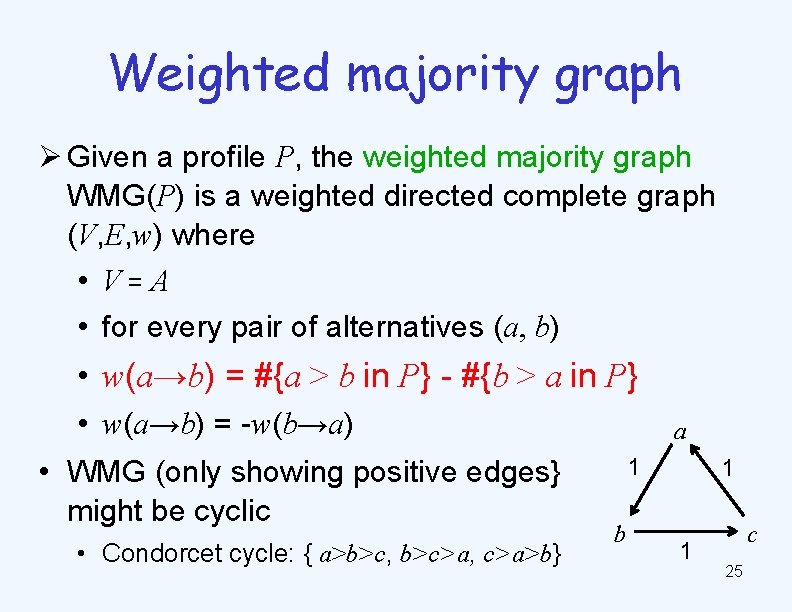
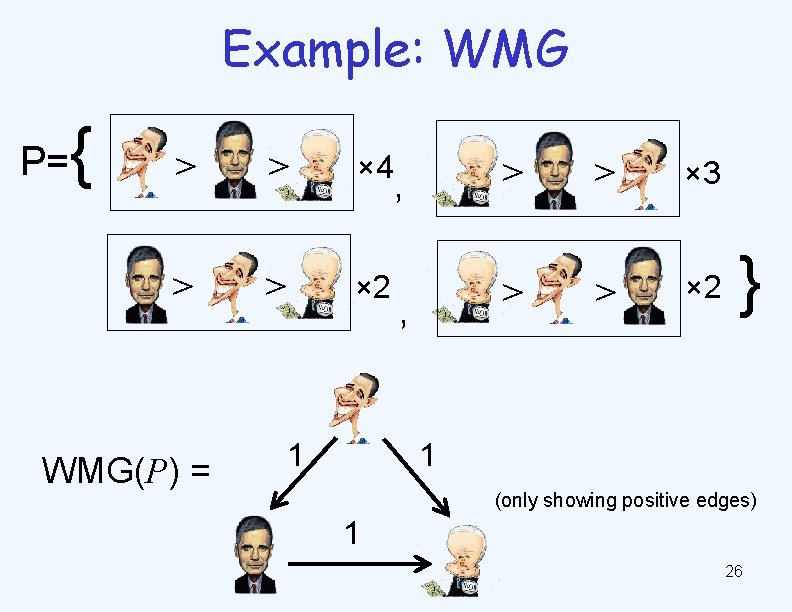
Weighted majority graph Ø Given a profile P, the weighted majority graph WMG(P) is a weighted directed complete graph (V, E, w) where • V=A • for every pair of alternatives (a, b) • w(a→b) = #{a > b in P} - #{b > a in P} • w(a→b) = -w(b→a) • WMG (only showing positive edges} might be cyclic • Condorcet cycle: { a>b>c, b>c>a, c>a>b} a 1 b 1 1 c 25
Example: WMG P= { > > × 4 > > × 2 WMG(P) = 1 , , > > × 3 > > × 2 } 1 (only showing positive edges) 1 26
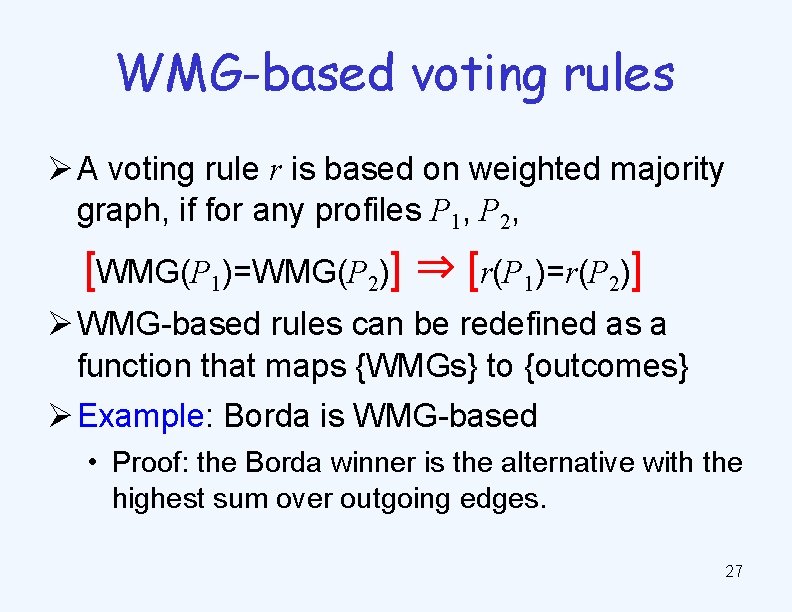
WMG-based voting rules Ø A voting rule r is based on weighted majority graph, if for any profiles P 1, P 2, [WMG(P 1)=WMG(P 2)] ⇒ [r(P 1)=r(P 2)] Ø WMG-based rules can be redefined as a function that maps {WMGs} to {outcomes} Ø Example: Borda is WMG-based • Proof: the Borda winner is the alternative with the highest sum over outgoing edges. 27
Voting with Prefpy Ø Implemented • All positional scoring rules • Bucklin, Copeland, maximin • not well-tested for weak orders Ø Project ideas • implementation of STV, ranked pairs, Kemeny • all are NP-hard to compute • extends all rules to weak orders 28
Popular criteria for voting rules (a. k. a. what people have done in the past 60 years) 29
How to evaluate and compare voting rules? Ø No single numerical criteria • Utilitarian: the joint decision should maximize the total happiness of the agents • Egalitarian: the joint decision should maximize the worst agent’s happiness Ø Axioms: properties that a “good” voting rules should satisfy • measures various aspects of preference aggregation 30
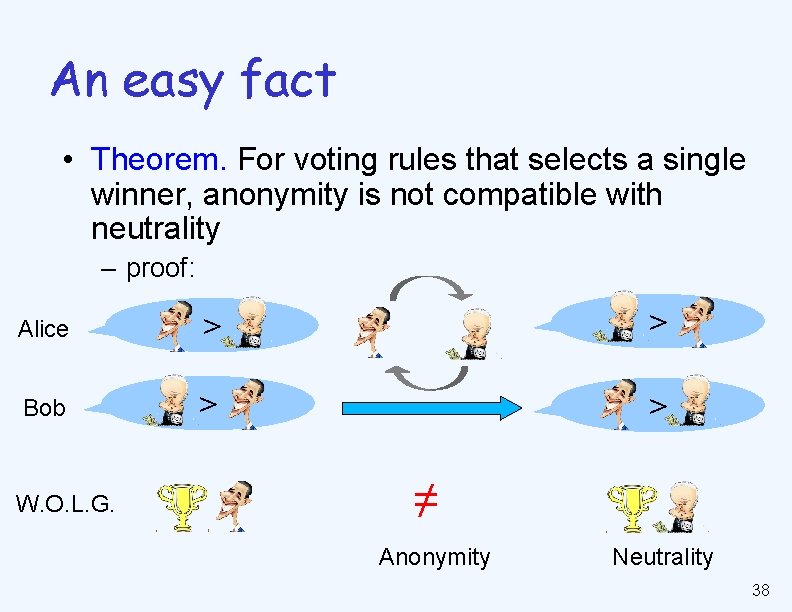
Fairness axioms Ø Anonymity: names of the voters do not matter • Fairness for the voters Ø Non-dictatorship: there is no dictator, whose top-ranked alternative is always the winner, no matter what the other votes are • Fairness for the voters Ø Neutrality: names of the alternatives do not matter • Fairness for the alternatives 31
A truth-revealing axiom Ø Condorcet consistency: Given a profile, if there exists a Condorcet winner, then it must win • The Condorcet winner beats all other alternatives in pairwise comparisons • The Condorcet winner only has positive outgoing edges in the WMG Ø Why this is truth-revealing? • why Condorcet winner is the truth? 32
The Condorcet Jury theorem [Condorcet 1785] Ø Given • two alternatives {a, b}. a: liable, b: not liable • 0. 5<p<1, Ø Suppose • given the ground truth (a or b), each voter’s preference is generated i. i. d. , such that • w/p p, the same as the ground truth • w/p 1 -p, different from the ground truth Ø Then, as n→∞, the probability for the majority of agents’ preferences is the ground truth goes to 1 Ø “lays, among other things, the foundations of the ideology of the democratic regime” (Paroush 1998) 33
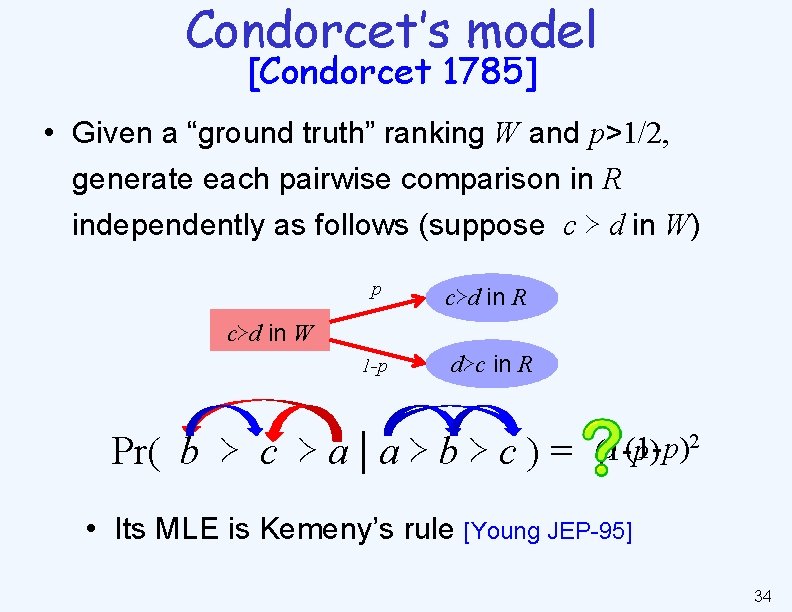
Condorcet’s model [Condorcet 1785] • Given a “ground truth” ranking W and p>1/2, generate each pairwise comparison in R independently as follows (suppose c ≻ d in W) p c≻d in R c≻d in W 1 -p d≻c in R Pr( b ≻ c ≻ a | a ≻ b ≻ c ) = p (1 -p)2 (1 -p) • Its MLE is Kemeny’s rule [Young JEP-95] 34
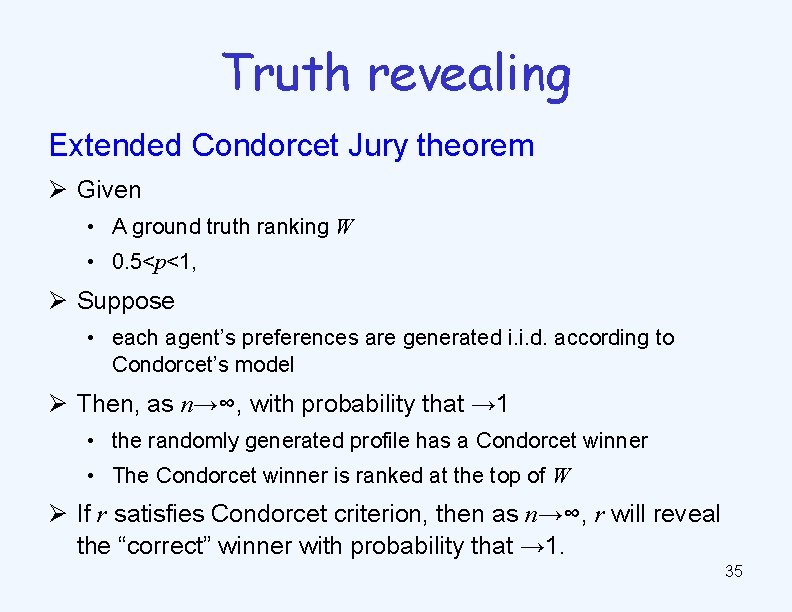
Truth revealing Extended Condorcet Jury theorem Ø Given • A ground truth ranking W • 0. 5<p<1, Ø Suppose • each agent’s preferences are generated i. i. d. according to Condorcet’s model Ø Then, as n→∞, with probability that → 1 • the randomly generated profile has a Condorcet winner • The Condorcet winner is ranked at the top of W Ø If r satisfies Condorcet criterion, then as n→∞, r will reveal the “correct” winner with probability that → 1. 35
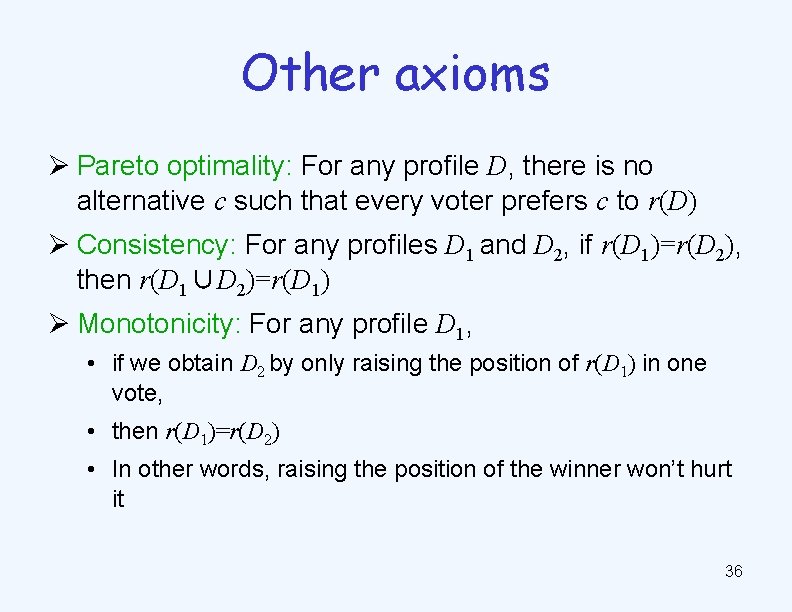
Other axioms Ø Pareto optimality: For any profile D, there is no alternative c such that every voter prefers c to r(D) Ø Consistency: For any profiles D 1 and D 2, if r(D 1)=r(D 2), then r(D 1∪D 2)=r(D 1) Ø Monotonicity: For any profile D 1, • if we obtain D 2 by only raising the position of r(D 1) in one vote, • then r(D 1)=r(D 2) • In other words, raising the position of the winner won’t hurt it 36
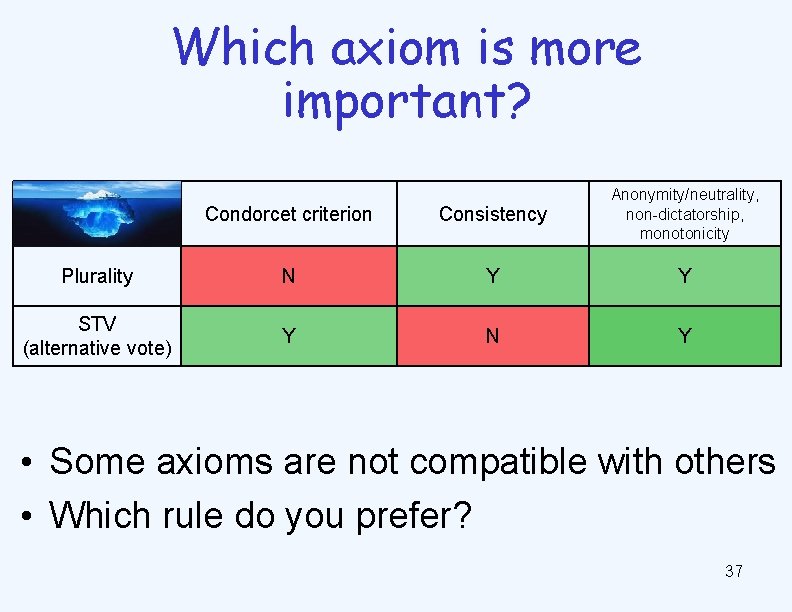
Which axiom is more important? Condorcet criterion Consistency Anonymity/neutrality, non-dictatorship, monotonicity Plurality N Y Y STV (alternative vote) Y N Y • Some axioms are not compatible with others • Which rule do you prefer? 37
An easy fact • Theorem. For voting rules that selects a single winner, anonymity is not compatible with neutrality – proof: Alice > > Bob > > W. O. L. G. ≠ Anonymity Neutrality 38
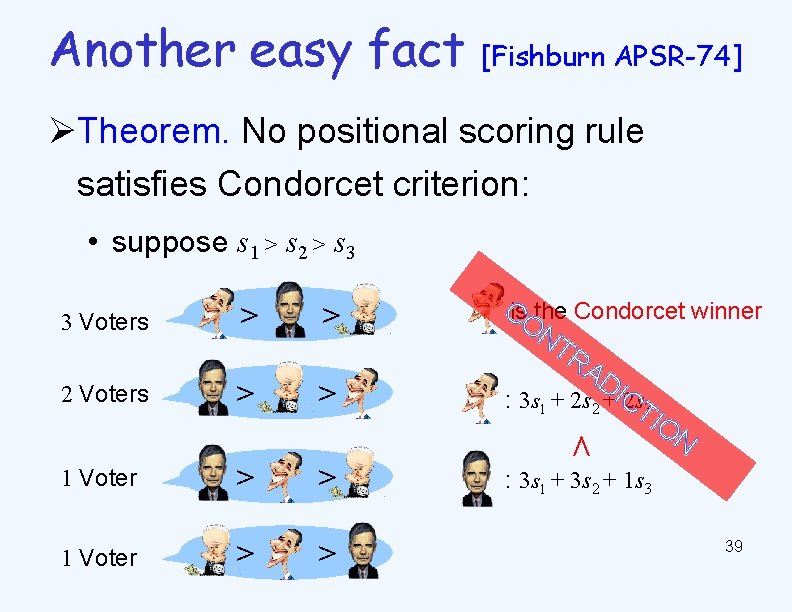
Another easy fact [Fishburn APSR-74] ØTheorem. No positional scoring rule satisfies Condorcet criterion: • suppose s 1 > s 2 > s 3 > 2 Voters > > 1 Voter > > Cis. Othe Condorcet winner NT RA DI : 3 s 1 + 2 s 2 + C 2 s. T 3 IO N < 3 Voters > : 3 s 1 + 3 s 2 + 1 s 3 39
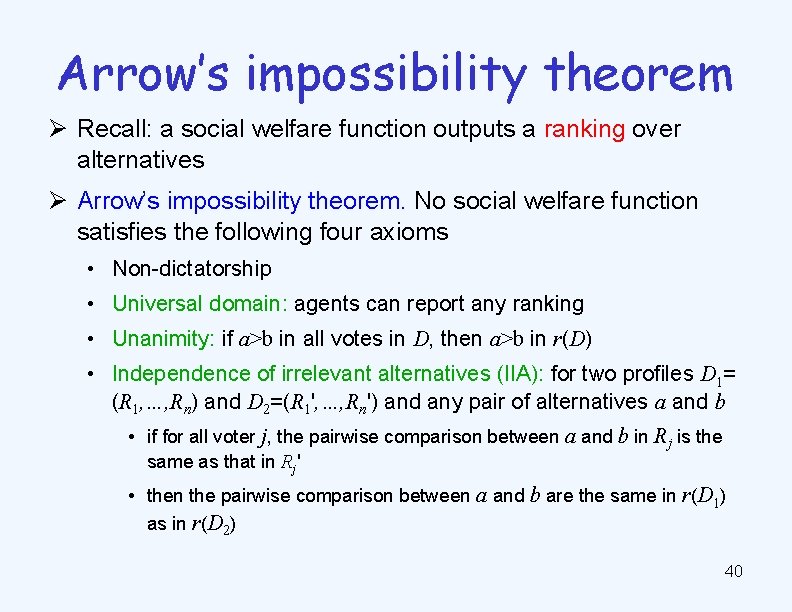
Arrow’s impossibility theorem Ø Recall: a social welfare function outputs a ranking over alternatives Ø Arrow’s impossibility theorem. No social welfare function satisfies the following four axioms • Non-dictatorship • Universal domain: agents can report any ranking • Unanimity: if a>b in all votes in D, then a>b in r(D) • Independence of irrelevant alternatives (IIA): for two profiles D 1= (R 1, …, Rn) and D 2=(R 1', …, Rn') and any pair of alternatives a and b • if for all voter j, the pairwise comparison between a and b in Rj is the same as that in Rj' • then the pairwise comparison between a and b are the same in r(D 1) as in r(D 2) 40
Other Not-So-Easy facts • Gibbard-Satterthwaite theorem – Later in the “hard to manipulate” class • Axiomatic characterization – Template: A voting rule satisfies axioms A 1, A 2 if it is rule X – If you believe in A 1 A 2 A 3 are the most desirable properties then X is optimal – (unrestricted domain+unanimity+IIA) dictatorships [Arrow] – (anonymity+neutrality+consistency+continuity) positional scoring rules [Young SIAMAM-75] – (neutrality+consistency+Condorcet consistency) Kemeny [Young&Levenglick SIAMAM-78] 41
Remembered all of these? ØImpressive! Now try a slightly larger tip of the iceberg at wiki 42
Change the world: 2011 UK Referendum Ø The second nationwide referendum in UK history • The first was in 1975 Ø Member of Parliament election: Plurality rule Alternative vote rule Ø 68% No vs. 32% Yes Ø Why people want to change? Ø Why it was not successful? Ø Which voting rule is the best? 43
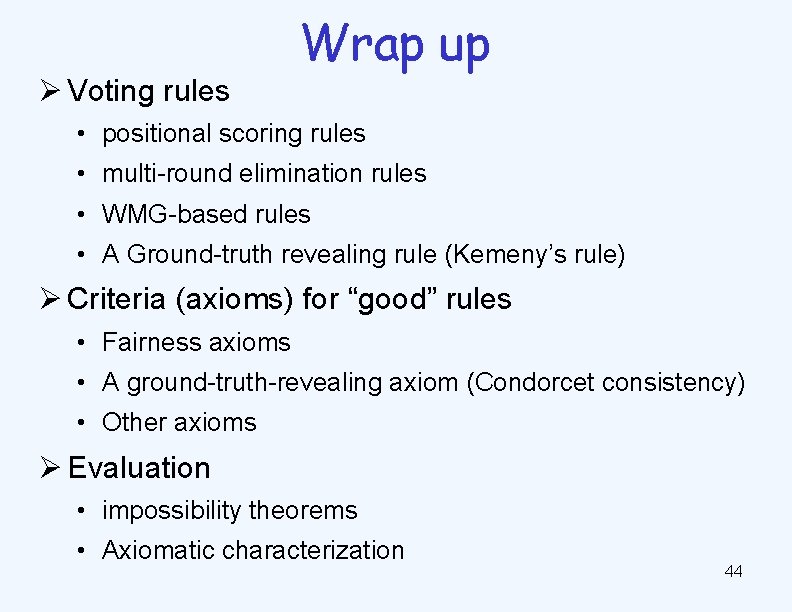
Ø Voting rules Wrap up • positional scoring rules • multi-round elimination rules • WMG-based rules • A Ground-truth revealing rule (Kemeny’s rule) Ø Criteria (axioms) for “good” rules • Fairness axioms • A ground-truth-revealing axiom (Condorcet consistency) • Other axioms Ø Evaluation • impossibility theorems • Axiomatic characterization 44