
0 Interest Rates and Bond Valuation Chapter 8
0 Interest Rates and Bond Valuation Chapter 8
1 Valuation of Bonds First Principle Value of financial securities = PV of expected future cash flows Bonds Find PV of coupons and par value Remember, interest rates are inversely related to present values
2 Bond: Definition Legally binding agreement between a borrower and a lender Principal amount Size and timing of the cash flows
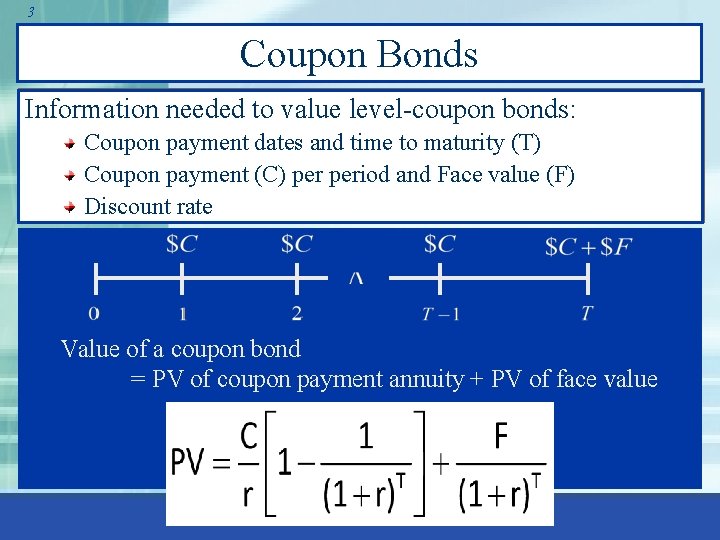
3 Coupon Bonds Information needed to value level-coupon bonds: Coupon payment dates and time to maturity (T) Coupon payment (C) period and Face value (F) Discount rate Value of a coupon bond = PV of coupon payment annuity + PV of face value
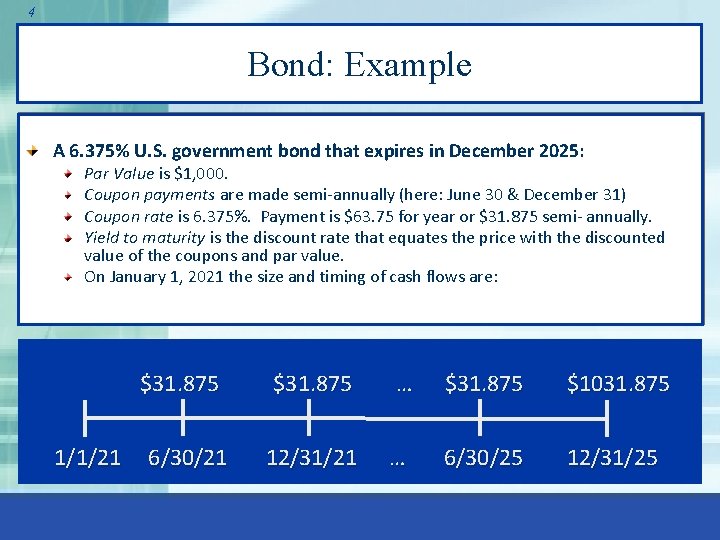
4 Bond: Example A 6. 375% U. S. government bond that expires in December 2025: Par Value is $1, 000. Coupon payments are made semi-annually (here: June 30 & December 31) Coupon rate is 6. 375%. Payment is $63. 75 for year or $31. 875 semi- annually. Yield to maturity is the discount rate that equates the price with the discounted value of the coupons and par value. On January 1, 2021 the size and timing of cash flows are: $31. 875 1/1/21 6/30/21 $31. 875 … $31. 875 $1031. 875 12/31/21 … 6/30/25 12/31/25
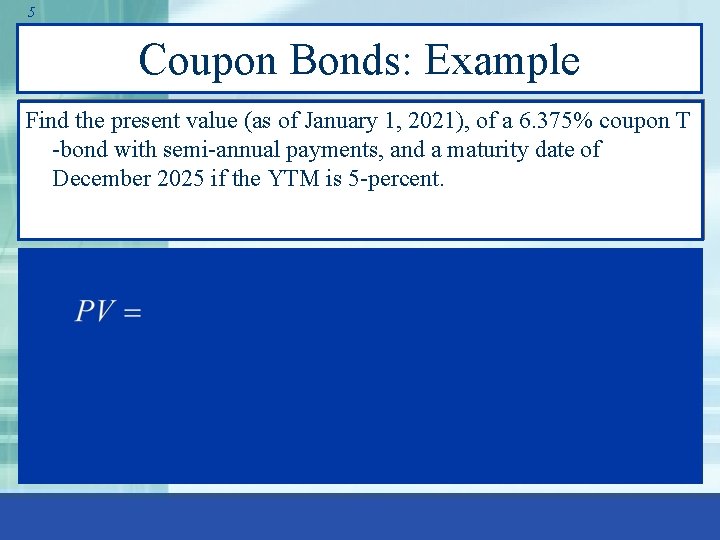
5 Coupon Bonds: Example Find the present value (as of January 1, 2021), of a 6. 375% coupon T -bond with semi-annual payments, and a maturity date of December 2025 if the YTM is 5 -percent.
6 Coupon Bonds: Example Now assume the required yield is 11%. How does this change the price? PV =
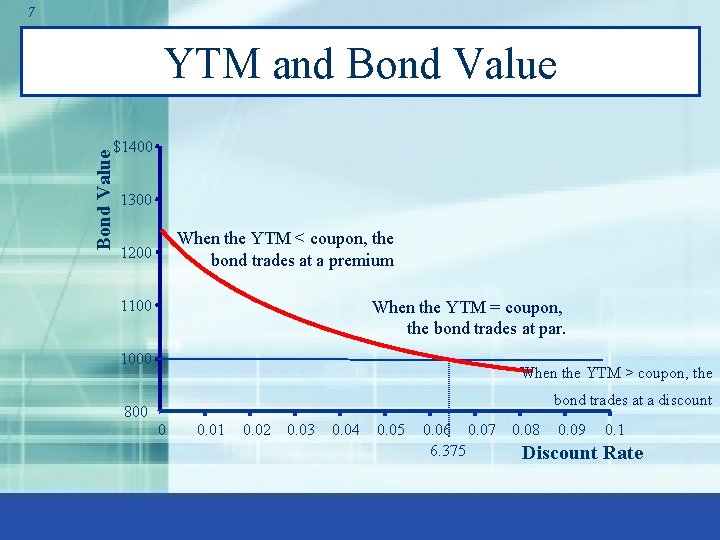
7 YTM and Bond Value $1400 1300 When the YTM < coupon, the bond trades at a premium. 1200 1100 When the YTM = coupon, the bond trades at par. 1000 When the YTM > coupon, the bond trades at a discount. 800 0 0. 01 0. 02 0. 03 0. 04 0. 05 0. 06 0. 07 6. 375 0. 08 0. 09 0. 1 Discount Rate
8 Interest Rate Risk Price Risk Change in price due to changes in interest rates Long-term bonds have more than short-term bonds Low coupon rate bonds have more than high coupon rate bonds
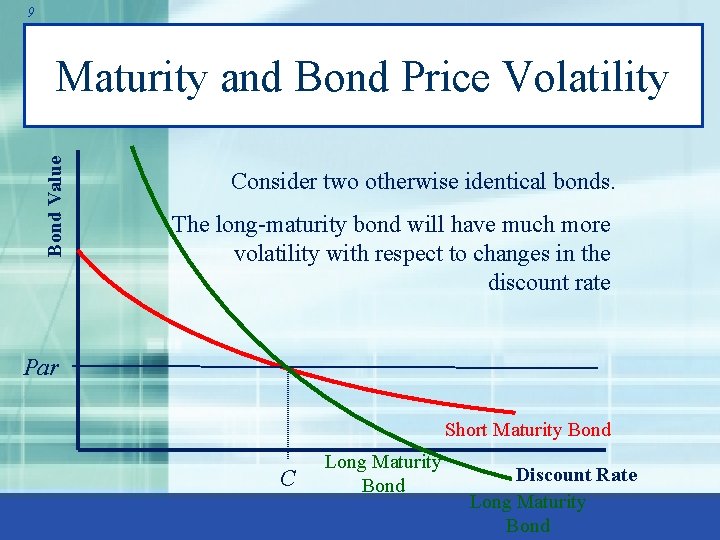
9 Bond Value Maturity and Bond Price Volatility Consider two otherwise identical bonds. The long-maturity bond will have much more volatility with respect to changes in the discount rate. Par Short Maturity Bond C Long Maturity Bond Discount Rate Long Maturity Bond
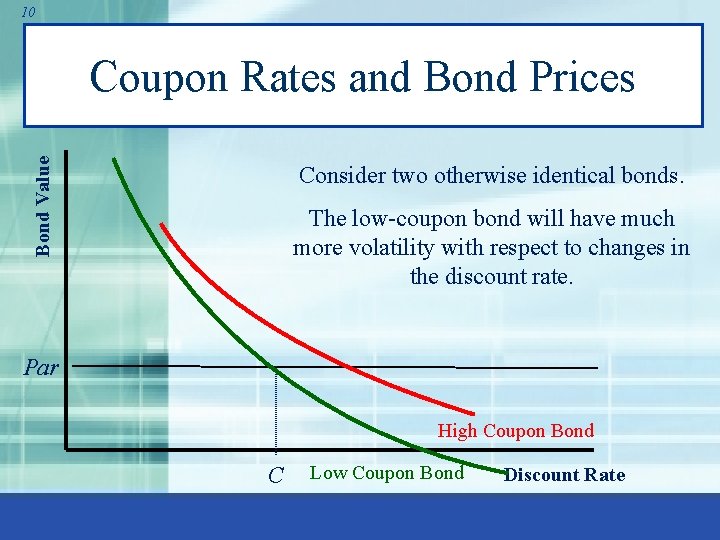
10 Bond Value Coupon Rates and Bond Prices Consider two otherwise identical bonds. The low-coupon bond will have much more volatility with respect to changes in the discount rate. Par High Coupon Bond C Low Coupon Bond Discount Rate
11 YTM Examples Consider a bond with a 10% annual coupon rate, 15 years to maturity, and a par value of $1, 000. The current price is $928. 09. Suppose a bond with a 10% coupon rate and semiannual coupons has a face value of $1, 000, 20 years to maturity, and is selling for $1, 197. 93.
12 Required Yields When issued, coupon = YTM The coupon rate depends on the risk characteristics of the bond when issued. Default risk
13 Bond Pricing Theorems Bonds of similar risk (and maturity) will be priced to yield about the same return, regardless of the coupon rate. If you know the price of one bond, you can estimate its YTM and use that to find the price of the second bond.
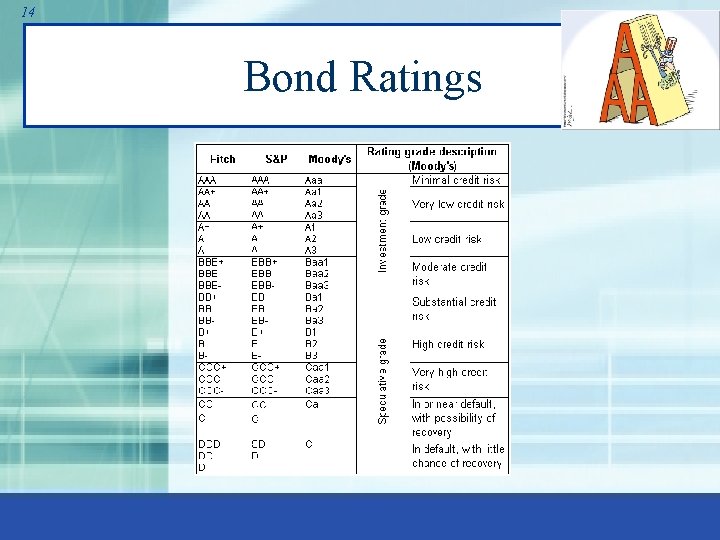
14 Bond Ratings
15 Zero Coupon Bonds No periodic interest payment YTM comes from purchase price and par Cannot sell for more than par Treasury bills, Treasury strips Side note on Treasuries T-bills: less than 1 year T-notes: 1 to 10 years T-bonds: Greater than 10
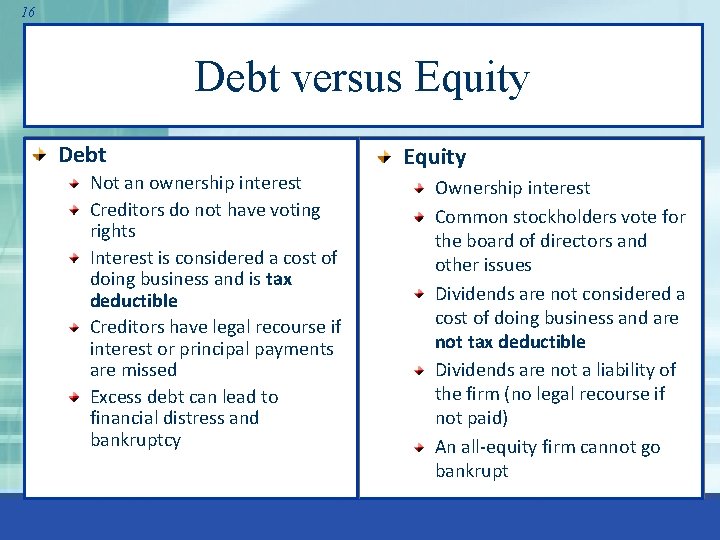
16 Debt versus Equity Debt Not an ownership interest Creditors do not have voting rights Interest is considered a cost of doing business and is tax deductible Creditors have legal recourse if interest or principal payments are missed Excess debt can lead to financial distress and bankruptcy Equity Ownership interest Common stockholders vote for the board of directors and other issues Dividends are not considered a cost of doing business and are not tax deductible Dividends are not a liability of the firm (no legal recourse if not paid) An all-equity firm cannot go bankrupt
17 Inflation and Interest Rates Real rate of interest – change in purchasing power Nominal rate of interest – quoted rate of interest, change in purchasing power and inflation Think of it as real plus adjustment for expected inflation
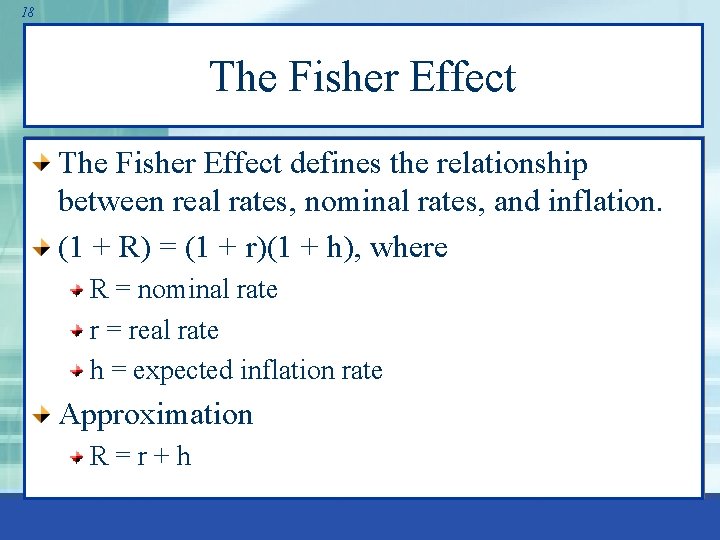
18 The Fisher Effect defines the relationship between real rates, nominal rates, and inflation. (1 + R) = (1 + r)(1 + h), where R = nominal rate r = real rate h = expected inflation rate Approximation R=r+h
19 The Fisher Effect Example: If we require a 8% real return and we expect inflation to be 3%, what is the nominal rate?
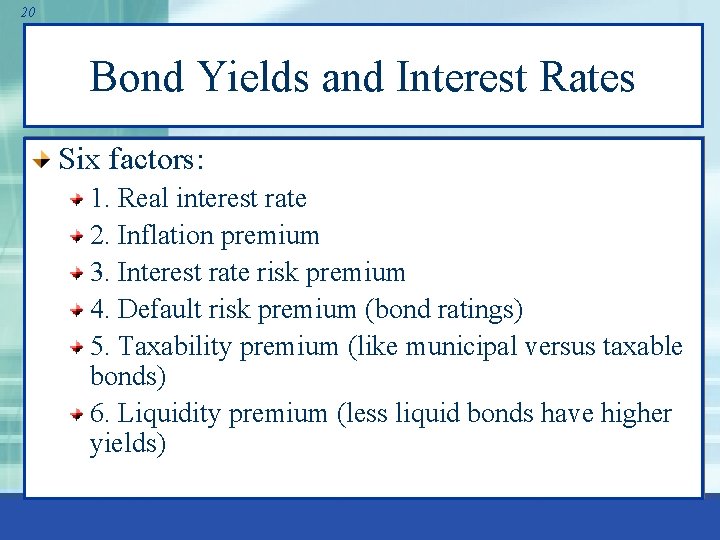
20 Bond Yields and Interest Rates Six factors: 1. Real interest rate 2. Inflation premium 3. Interest rate risk premium 4. Default risk premium (bond ratings) 5. Taxability premium (like municipal versus taxable bonds) 6. Liquidity premium (less liquid bonds have higher yields)
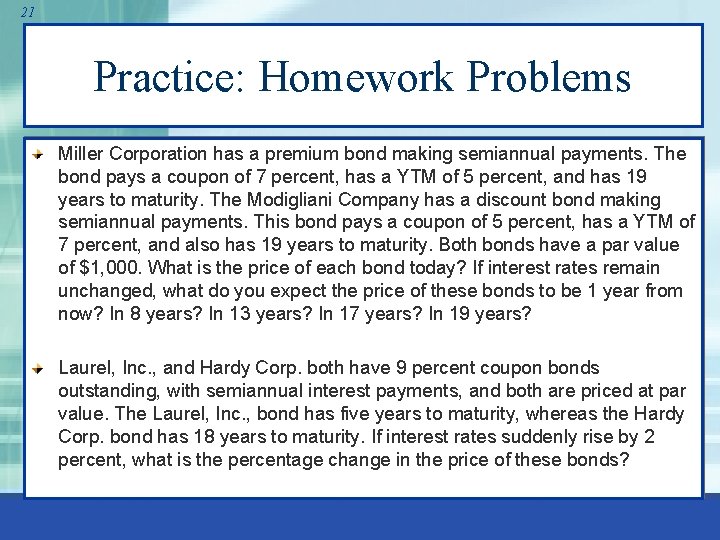
21 Practice: Homework Problems Miller Corporation has a premium bond making semiannual payments. The bond pays a coupon of 7 percent, has a YTM of 5 percent, and has 19 years to maturity. The Modigliani Company has a discount bond making semiannual payments. This bond pays a coupon of 5 percent, has a YTM of 7 percent, and also has 19 years to maturity. Both bonds have a par value of $1, 000. What is the price of each bond today? If interest rates remain unchanged, what do you expect the price of these bonds to be 1 year from now? In 8 years? In 13 years? In 17 years? In 19 years? Laurel, Inc. , and Hardy Corp. both have 9 percent coupon bonds outstanding, with semiannual interest payments, and both are priced at par value. The Laurel, Inc. , bond has five years to maturity, whereas the Hardy Corp. bond has 18 years to maturity. If interest rates suddenly rise by 2 percent, what is the percentage change in the price of these bonds?
- Slides: 22