
0 Changing Times for Financial Institutions Chapter 1
- Slides: 31
0 Changing Times for Financial Institutions Chapter 1 Copyright © 2004 by Thomson Southwestern All rights reserved.
1 Changing Times, 1930 – 1980 s 1930 s U. S. financial system shaped by: • • The Great Depression New Regulations to bring stability & safety 1970 s– 1980 s Major change factors were: • • • Inflation (and higher interest rates to control it) Technological Change Deregulation ◦ Interest bearing checking accounts ◦ Money market mutual funds ◦ More open entry into banking Copyright © 2004 by Thomson Southwestern All rights reserved.
2 Changing Times, 1990 s – Future 1990 s • • Major change factors were: Globalization Expansion in both geography & services Consolidation Re-regulation 2000 - Future Major continuing concerns: • • • Risk management Operational risk Greater competition, global and domestic Copyright © 2004 by Thomson Southwestern All rights reserved.
3 Opportunities of the 21 st Century New technology • • • Proliferation of new services Development of new market areas Reduction of operational costs Globalization • • Growth of international financial institutions Increased competition for customers and markets Specialized niches for “boutique” firms Copyright © 2004 by Thomson Southwestern All rights reserved.
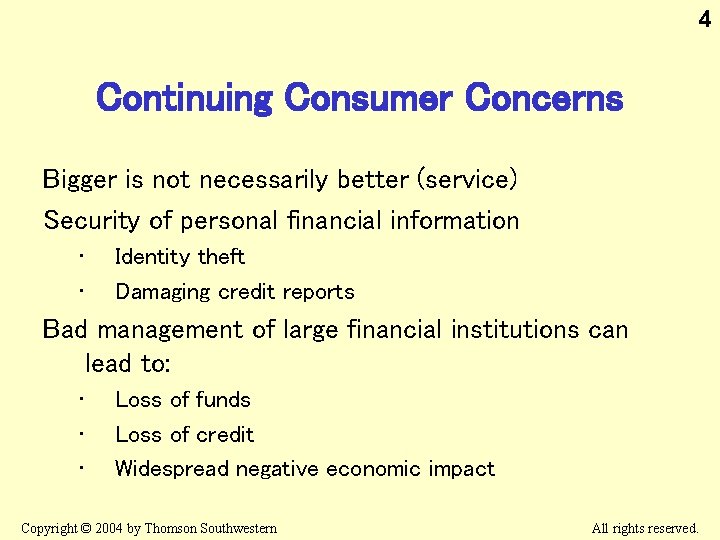
4 Continuing Consumer Concerns Bigger is not necessarily better (service) Security of personal financial information • • Identity theft Damaging credit reports Bad management of large financial institutions can lead to: • • • Loss of funds Loss of credit Widespread negative economic impact Copyright © 2004 by Thomson Southwestern All rights reserved.
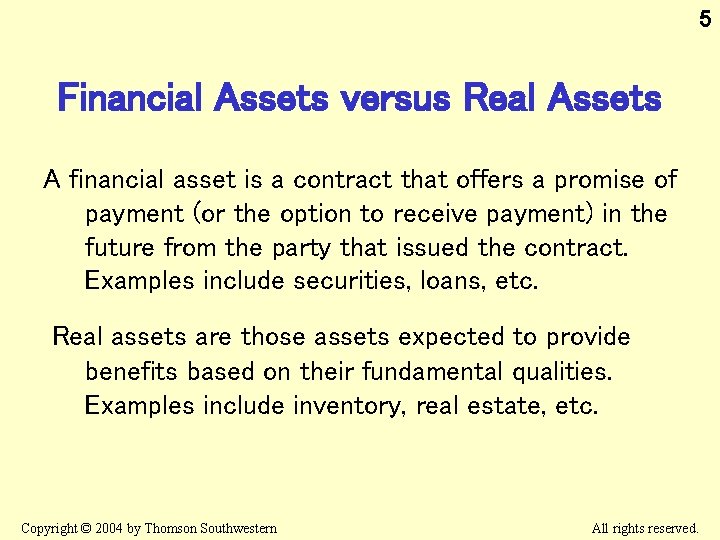
5 Financial Assets versus Real Assets A financial asset is a contract that offers a promise of payment (or the option to receive payment) in the future from the party that issued the contract. Examples include securities, loans, etc. Real assets are those assets expected to provide benefits based on their fundamental qualities. Examples include inventory, real estate, etc. Copyright © 2004 by Thomson Southwestern All rights reserved.
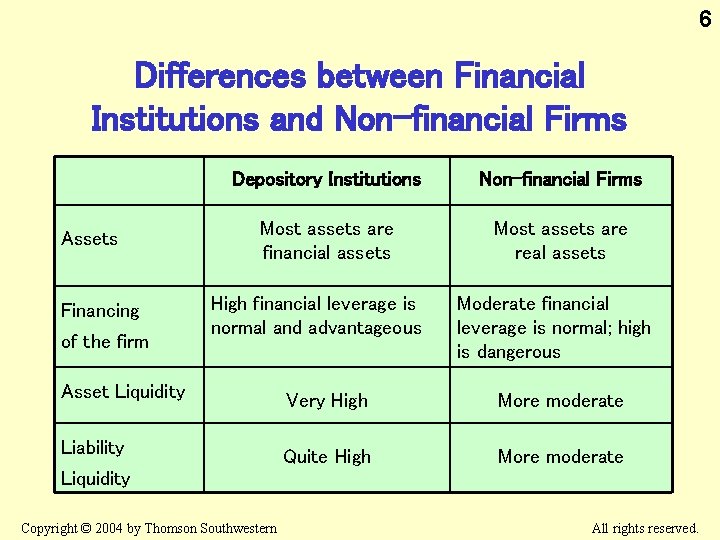
6 Differences between Financial Institutions and Non-financial Firms Assets Financing of the firm Depository Institutions Non-financial Firms Most assets are financial assets Most assets are real assets High financial leverage is normal and advantageous Moderate financial leverage is normal; high is dangerous Asset Liquidity Very High More moderate Liability Quite High More moderate Liquidity Copyright © 2004 by Thomson Southwestern All rights reserved.
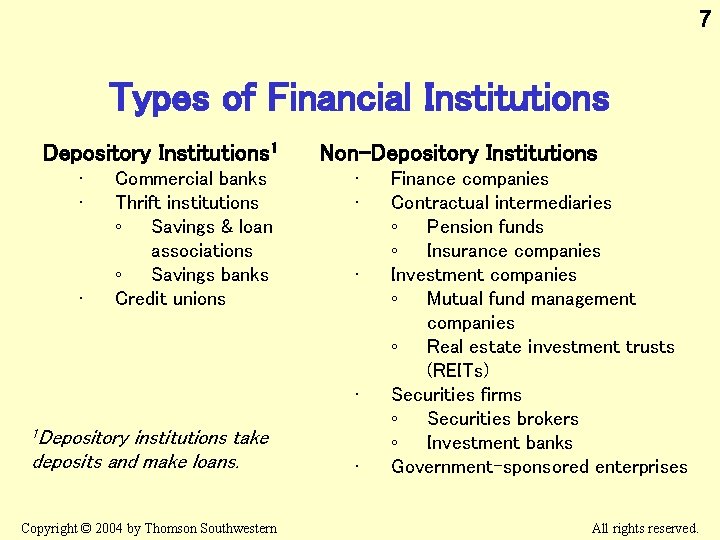
7 Types of Financial Institutions Depository Institutions 1 • • • Commercial banks Thrift institutions ◦ Savings & loan associations ◦ Savings banks Credit unions Non-Depository Institutions • • 1 Depository institutions take deposits and make loans. Copyright © 2004 by Thomson Southwestern • Finance companies Contractual intermediaries ◦ Pension funds ◦ Insurance companies Investment companies ◦ Mutual fund management companies ◦ Real estate investment trusts (REITs) Securities firms ◦ Securities brokers ◦ Investment banks Government-sponsored enterprises All rights reserved.
8 Depository Institutions Depository institutions • are financial institutions that take deposits and make loans • control the largest proportion of financial assets. Depositors are protected from loss of funds by deposit insurance via quasi-federal agencies • Builds depositor’s confidence in financial system • Provides another level of regulatory oversight Copyright © 2004 by Thomson Southwestern All rights reserved.
9 Commercial Banks hold primarily securities and loans as assets Banks have been the primary source of short-term and intermediate-term loans Their loan portfolio is the most diversified and credit risk is their largest risk Banks major source of funds are customer deposits Copyright © 2004 by Thomson Southwestern All rights reserved.
10 Thrift Institutions Savings and loan associations (S&Ls) and savings banks traditionally rely on savings deposits as sources of funds. S&Ls have expanded beyond their traditional role as mortgage suppliers. Savings banks resemble S&Ls, but they have more diversified asset bases. Copyright © 2004 by Thomson Southwestern All rights reserved.
11 Credit Unions (CUs) CUs are not-for-profit organizations CUs are subject to a common bond requirement and cannot make commercial loans CUs have aggressively stretched common bond boundaries, becoming more like banks by offering credit cards and other investment services Copyright © 2004 by Thomson Southwestern All rights reserved.
12 Finance Companies Finance companies provide • • • Loans to businesses and consumers who can not qualify for bank loans Provide liquidity to businesses by financing their most liquid assets (accounts receivable) Loans at higher interest rates than banks Major sources of funds include • • Loans from commercial banks Selling commercial paper and bonds Copyright © 2004 by Thomson Southwestern All rights reserved.
13 Contractual Intermediaries Operate under formal agreements with policyholders or pensioners who entrust their funds to these firms. Provide financial vehicles for • • Risk management Retirement savings Defined contribution retirement plans have largely replaced defined benefit plans Assets are primarily long term investments Copyright © 2004 by Thomson Southwestern All rights reserved.
14 Investment Companies Investment companies include mutual funds, money market funds, and REITs Provides professional management of diversified portfolios to individual investors Economies of scale offer the benefits of: • • • professional management reduced costs reduced risk exposure within large, diversified portfolios. Copyright © 2004 by Thomson Southwestern All rights reserved.
15 Securities Firms Provide retail brokerage services including buying and selling stocks, bonds, and other financial assets for customers Make a market in financial securities by buying and selling the same securities themselves Sell investment banking services including the creation and issuance of new securities (individual public offerings or IPOs) Provide financial consulting services Copyright © 2004 by Thomson Southwestern All rights reserved.
16 Government-Sponsored Enterprises Include: • • • Federal National Mortgage Association Government National Mortgage Association Federal Home Loan Mortgage Corporation Provides a secondary market • • Packages of mortgages can be bought and sold Provides liquidity for mortgage-issuing institutions Copyright © 2004 by Thomson Southwestern All rights reserved.
17 Industry Differences Major differences exist between financial institutions in their • • Asset and liability distributions Services offered to the public Riskiness of invested funds Legal structure There are significant differences in the laws regulating their operations and government agencies acting as regulators. Copyright © 2004 by Thomson Southwestern All rights reserved.
18 Economic Functions of Financial Institutions Intermediation (transfer of funds, securities) Reduced transactions and information costs Liquidity • • For markets For individual parties (companies or individuals) Information and contacts Transfer of risk Creation of financial instruments Creation of money Copyright © 2004 by Thomson Southwestern All rights reserved.
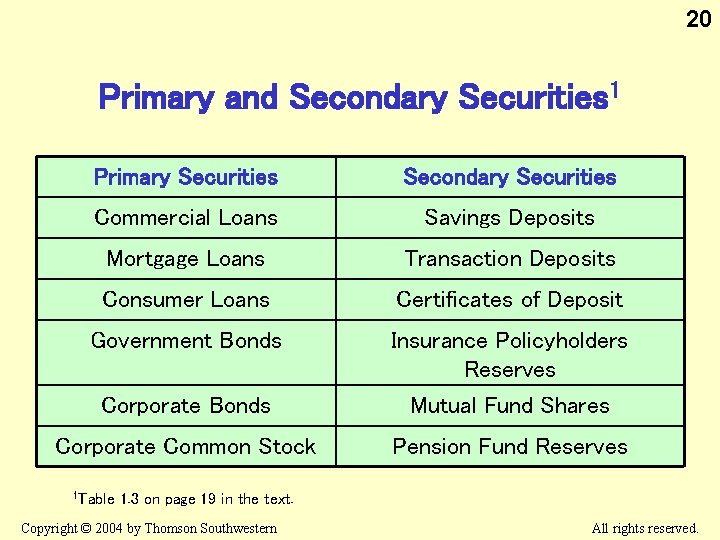
19 Primary versus Secondary Securities and Markets For securities • • Primary (direct) securities are claims against individuals, governments, and nonfinancial firms. Secondary (indirect) securities are financial liabilities of financial institutions. For Markets • • Primary markets: Securities are initially offered (IPO) and issuing party receives the funds Secondary markets: Outstanding securities are traded from one holder to another and issuing party receives no funds. Copyright © 2004 by Thomson Southwestern All rights reserved.
20 Primary and Secondary Securities 1 Primary Securities Secondary Securities Commercial Loans Savings Deposits Mortgage Loans Transaction Deposits Consumer Loans Certificates of Deposit Government Bonds Corporate Bonds Insurance Policyholders Reserves Mutual Fund Shares Corporate Common Stock Pension Fund Reserves 1 Table 1. 3 on page 19 in the text. Copyright © 2004 by Thomson Southwestern All rights reserved.
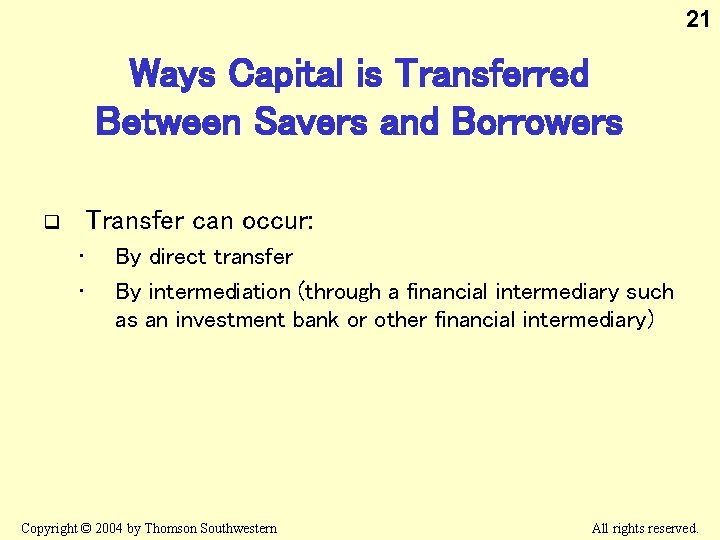
21 Ways Capital is Transferred Between Savers and Borrowers Transfer can occur: q • • By direct transfer By intermediation (through a financial intermediary such as an investment bank or other financial intermediary) Copyright © 2004 by Thomson Southwestern All rights reserved.
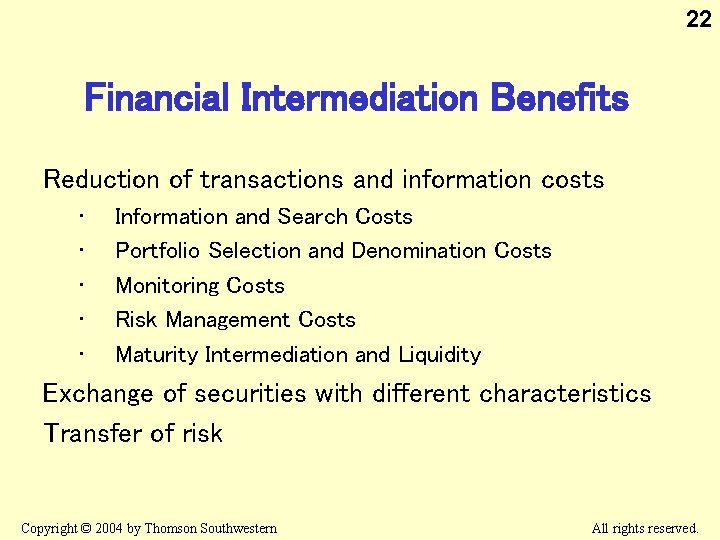
22 Financial Intermediation Benefits Reduction of transactions and information costs • • • Information and Search Costs Portfolio Selection and Denomination Costs Monitoring Costs Risk Management Costs Maturity Intermediation and Liquidity Exchange of securities with different characteristics Transfer of risk Copyright © 2004 by Thomson Southwestern All rights reserved.
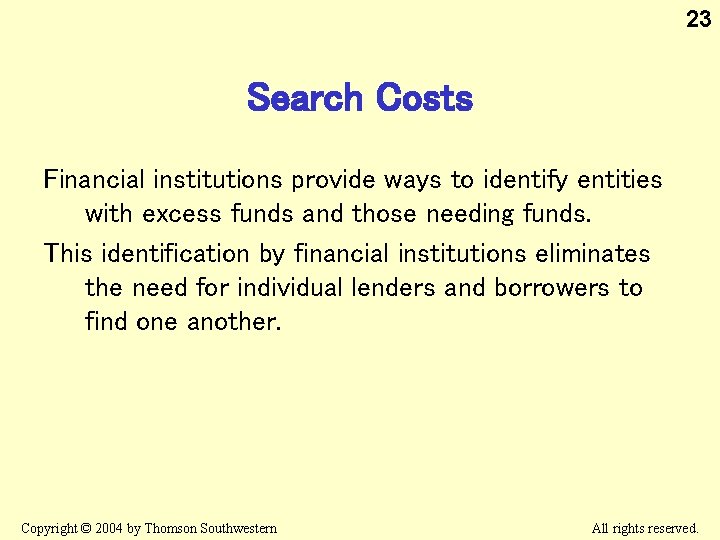
23 Search Costs Financial institutions provide ways to identify entities with excess funds and those needing funds. This identification by financial institutions eliminates the need for individual lenders and borrowers to find one another. Copyright © 2004 by Thomson Southwestern All rights reserved.
24 Portfolio Selection Costs Investors may wish to invest in financial assets in different dollar amounts, with different maturities, or with different risk levels from the financial liabilities borrowers wish to issue. Financial institutions issue secondary securities to lenders, and then repackage funds in forms attractive to borrowers. Copyright © 2004 by Thomson Southwestern All rights reserved.
25 Monitoring Costs Asymmetric information exists when managers have one set of information and investors have a different set of information. Managers are generally better informed about their firm’s prospects, so they generally have a better set of information. Information asymmetry gives rise to monitoring costs - ongoing expenses incurred by investors to gather information so they can intervene if borrowers’ financial situations change. Copyright © 2004 by Thomson Southwestern All rights reserved.
26 Risk Management Costs Investors can avoid the risk of a single party defaulting on its obligations by holding shares in a mutual fund Insurance companies can pool premiums and provide risk management at much lower cost Banks provide letters of credit that guarantee payment by other parties, reducing risk Investment and commercial banks provide instruments that can protect against interest rate and foreign exchange risk Copyright © 2004 by Thomson Southwestern All rights reserved.
27 Maturity Intermediation and Liquidity Banks accept small amounts from small investors as deposits and transform them into longer-term loans Banks borrow short-term (from depositors) and lend longer-term Checks, credit cards, electronic payments, and bank wires can be used to make payments in lieu of cash Copyright © 2004 by Thomson Southwestern All rights reserved.
28 The Changing Role of Financial Institutions in the Technological Age New risks with technology Societal Concerns • • • Serving the community Services for the “unbanked” Community Reinvestment Accounting & Ethical Concerns • • • Enron Arthur Anderson Investment bankers providing false information Mutual fund management practices Corporate Governance Scandals Copyright © 2004 by Thomson Southwestern All rights reserved.
29 Financial Institution Management Who sets objectives? • • • Stockholders versus stakeholders Normative versus positive theory approach Agency theory Customer needs Regulations providing limits What is the goal of the firm? Copyright © 2004 by Thomson Southwestern All rights reserved.
30 Economic Value Added (EVA) A goal for risk-profitability management Measures profitability after • • Long term debtholders earn their return Stockholders and other investors earn their return Can be used for individual capital allocation decisions Copyright © 2004 by Thomson Southwestern All rights reserved.