
0 2 Real Numbers HOW DO WE CLASSIFY
0 -2: Real Numbers HOW DO WE CLASSIFY AND USE REAL NUMBERS?
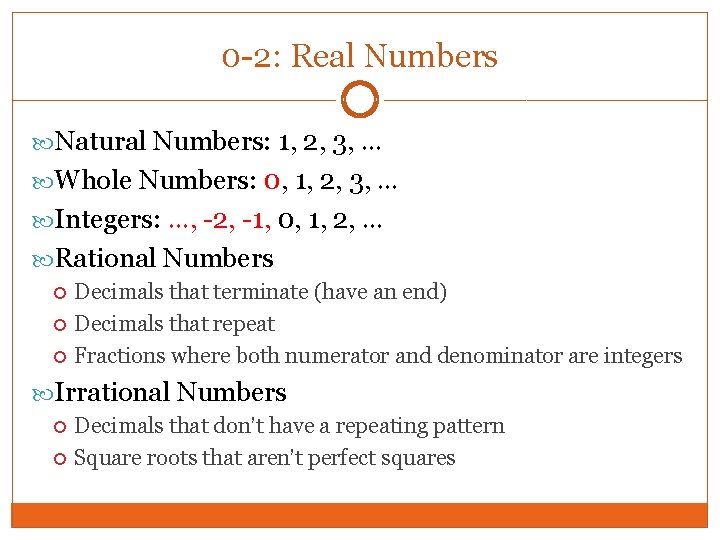
0 -2: Real Numbers Natural Numbers: 1, 2, 3, … Whole Numbers: 0, 1, 2, 3, … Integers: …, -2, -1, 0, 1, 2, … Rational Numbers Decimals that terminate (have an end) Decimals that repeat Fractions where both numerator and denominator are integers Irrational Numbers Decimals that don’t have a repeating pattern Square roots that aren’t perfect squares
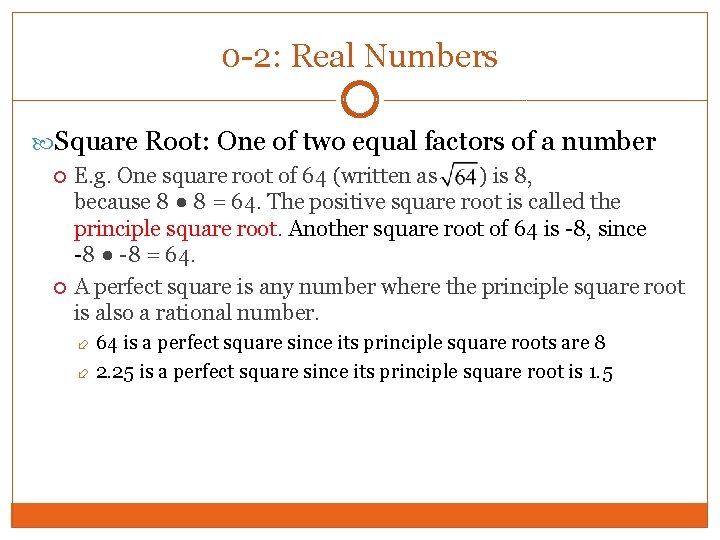
0 -2: Real Numbers Square Root: One of two equal factors of a number E. g. One square root of 64 (written as ) is 8, because 8 ● 8 = 64. The positive square root is called the principle square root. Another square root of 64 is -8, since -8 ● -8 = 64. A perfect square is any number where the principle square root is also a rational number. 64 is a perfect square since its principle square roots are 8 2. 25 is a perfect square since its principle square root is 1. 5
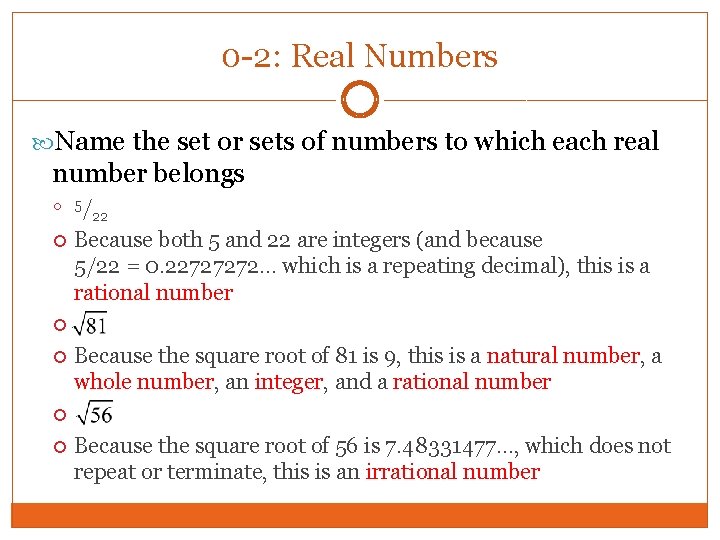
0 -2: Real Numbers Name the set or sets of numbers to which each real number belongs 5/ 22 Because both 5 and 22 are integers (and because 5/22 = 0. 22727272… which is a repeating decimal), this is a rational number Because the square root of 81 is 9, this is a natural number, a whole number, an integer, and a rational number Because the square root of 56 is 7. 48331477…, which does not repeat or terminate, this is an irrational number
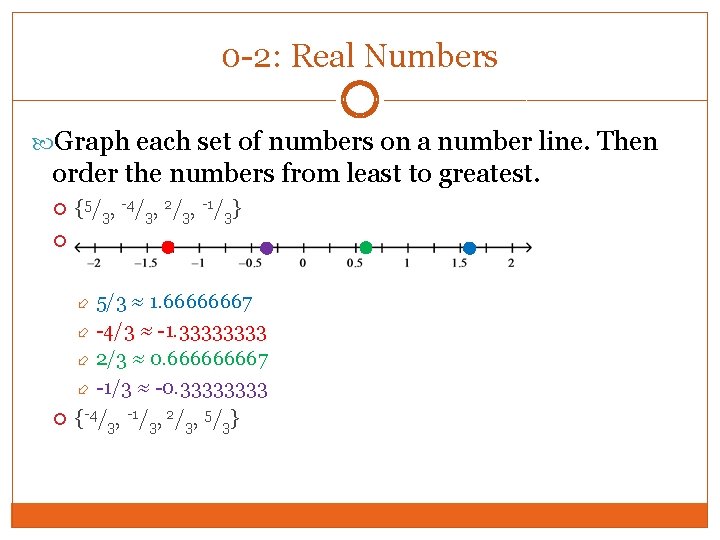
0 -2: Real Numbers Graph each set of numbers on a number line. Then order the numbers from least to greatest. {5/3, -4/3, 2/3, -1/3} 5/3 ≈ 1. 66666667 -4/3 ≈ -1. 3333 2/3 ≈ 0. 66667 -1/3 ≈ -0. 3333 {-4/3, -1/3, 2/3, 5/3}
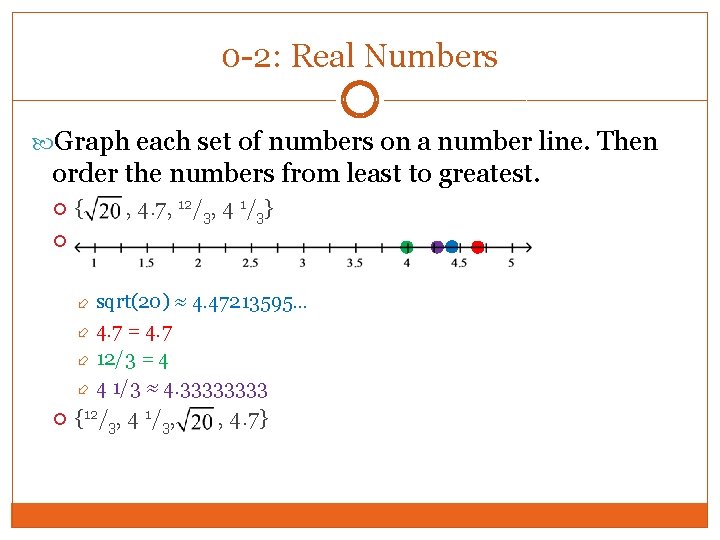
0 -2: Real Numbers Graph each set of numbers on a number line. Then order the numbers from least to greatest. { , 4. 7, 12/3, 4 1/3} sqrt(20) ≈ 4. 47213595… 4. 7 = 4. 7 12/3 = 4 4 1/3 ≈ 4. 3333 {12/3, 4 1/3, , 4. 7}
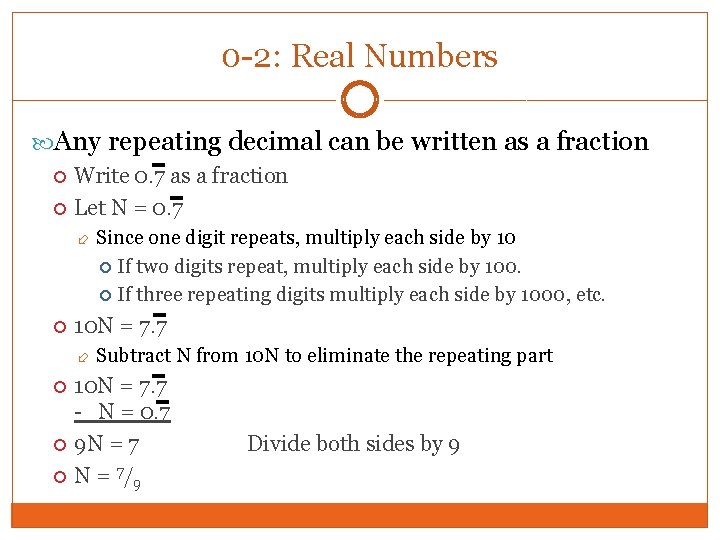
0 -2: Real Numbers Any repeating decimal can be written as a fraction Write 0. 7 as a fraction Let N = 0. 7 10 N = 7. 7 Since one digit repeats, multiply each side by 10 If two digits repeat, multiply each side by 100. If three repeating digits multiply each side by 1000, etc. Subtract N from 10 N to eliminate the repeating part 10 N = 7. 7 - N = 0. 7 9 N = 7/ 9 Divide both sides by 9
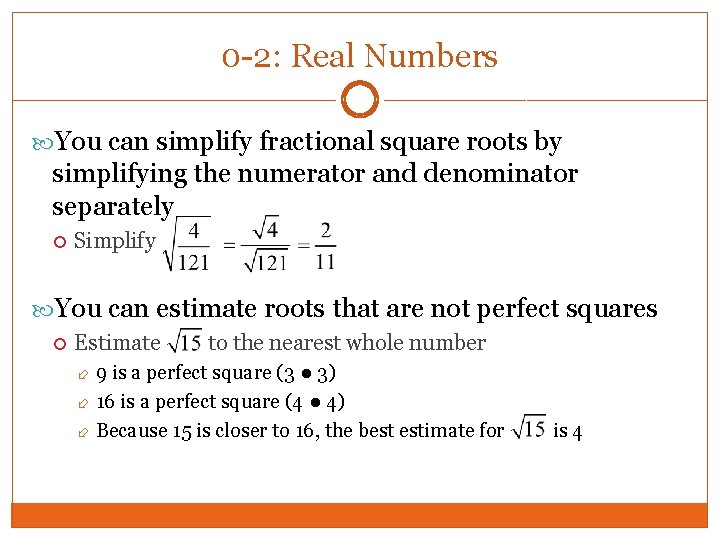
0 -2: Real Numbers You can simplify fractional square roots by simplifying the numerator and denominator separately Simplify You can estimate roots that are not perfect squares Estimate to the nearest whole number 9 is a perfect square (3 ● 3) 16 is a perfect square (4 ● 4) Because 15 is closer to 16, the best estimate for is 4
0 -2: Real Numbers Assignment Page P 10 Problems 1 – 35, odds
- Slides: 9